
Downspout Installation in Sunnyvale, TX That Protects Your Foundation
Downspouts placed to move water away from your foundation on Sunnyvale clay soil – starting with a free inspection of where the water goes now.
What’s Covered on This Page
- Signs Your Home Needs New Downspouts
- Why Downspout Placement Matters on Sunnyvale’s Clay Soil
- When a Repair or Extension Is Enough
- What Happens During a Downspout Installation Inspection
- What Drives Downspout Installation Cost
- Can pests get into my downspouts?
- Will a buried downspout drain line clog over time?
- Does hydro jetting apply to downspout drain lines?
Signs Your Home Needs New Downspouts
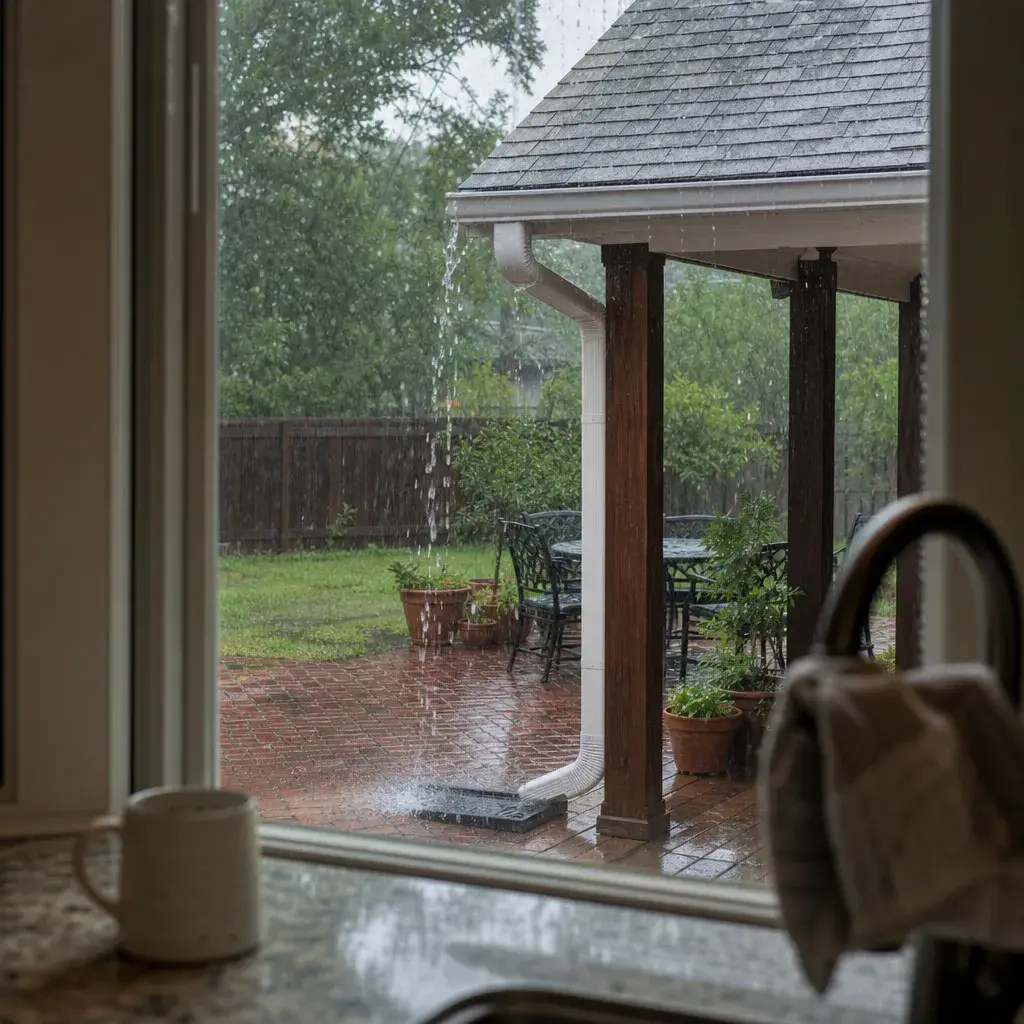
Most downspout problems show up on the ground before you ever look up. Your gutters catch the water, but your downspouts decide where it lands. In Sunnyvale, that’s a big deal. Most homes here sit on a concrete slab over clay soil that swells when soaked and shrinks when dry. When a downspout dumps a whole roof’s worth of rain right at the corner of your house, that soil gets far wetter there than anywhere else.
Walk around your house after the next hard rain and look for these:
- Puddles that sit against the slab or brick for hours after the rain stops.
- A bare, washed-out trench or a pile of mulch and soil swept away where the downspout empties.
- Gutters that spill over at the corners or in the middle of a long run, even though they’re clean. That often means there aren’t enough downspouts, or the ones you have are too small for the roof area they drain.
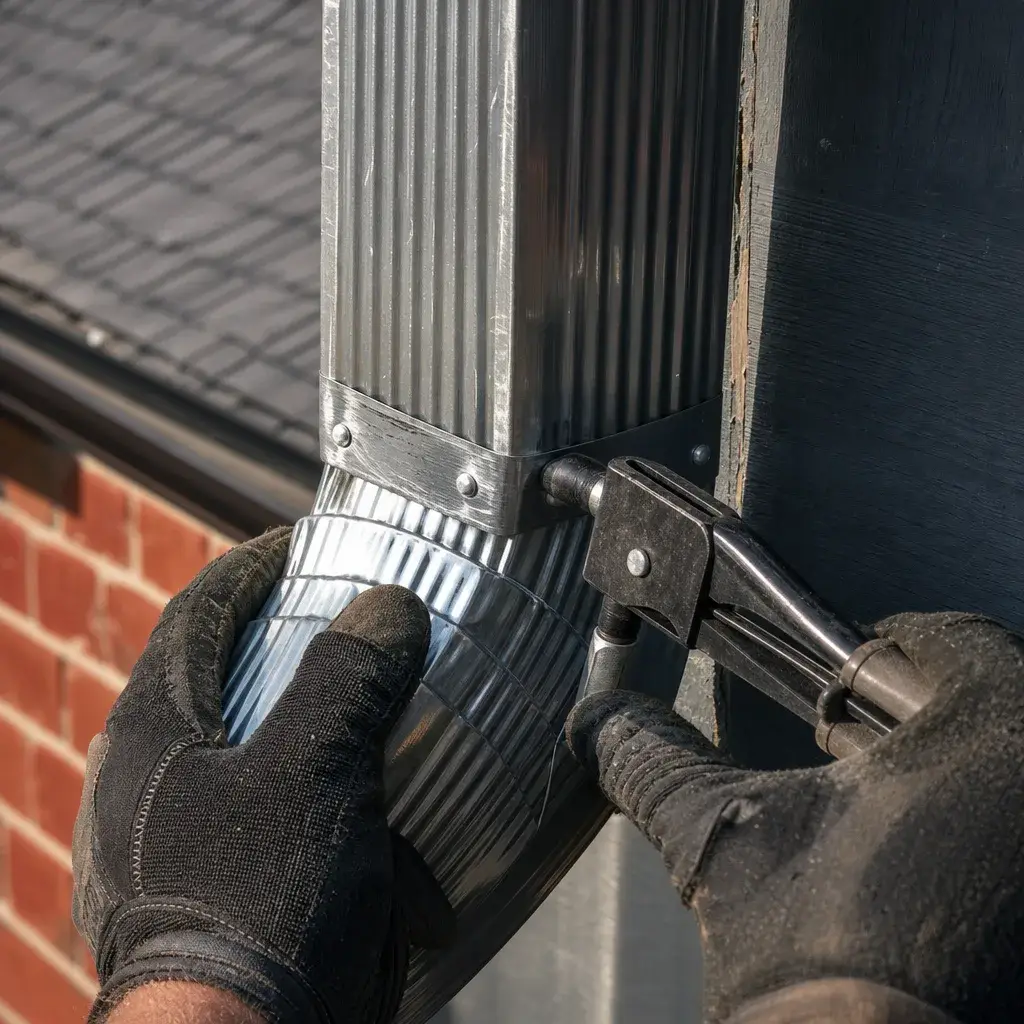
- Water shooting out of the joints, elbows, or seams instead of coming out the bottom.
- Dents, kinks, or crushed sections from hail, a ladder, a mower, or a trash can backed into them. A crushed downspout chokes the flow.
- Rust spots or pinholes, which are common on older galvanized steel downspouts.
- Sections pulling away from the wall, or a downspout that no longer lines up with the gutter outlet.
- Dark streaks on the brick, peeling paint on the trim, or soft, rotting fascia right where the downspout connects.
Spring hail season, roughly March through June in North Texas, is a good time to check. The same storms that dent shingles also flatten thin downspouts. Heavy downpours show you right away whether your system keeps up. A downspout can look fine and still be crushed at the bottom elbow where you can’t see it.
Watch for slower clues, too. A gap opening up between the soil and your slab in a dry August, then closing again after spring rains, tells you the ground at that corner is going through big wet and dry swings. Uneven drainage is one thing that can feed those swings. It’s not proof of a foundation problem, but it’s a reason to make sure your downspouts carry water well away from the house.
Not every sign means you need new downspouts. A single section that came loose can often be reattached with a new strap. A downspout that’s simply packed with leaves and roof grit may just need to be cleared. A missing splash block or extension is an easy fix. The signs that point to new downspouts are the ones that keep coming back: overflow in every storm, a wet corner that never dries out, metal that’s rusted through, or damage along the whole run. Those mean the size, number, or placement of your downspouts doesn’t fit your roof, and patching one piece won’t change where the water goes.
Why Downspout Placement Matters on Sunnyvale’s Clay Soil
A downspout’s job isn’t just to get water off your roof. It’s to put that water somewhere your slab won’t feel it. Since the clay under Sunnyvale homes swells and shrinks with moisture, the goal is to keep the soil around your house about evenly damp on every side. You don’t want one soaked corner and three dry ones. Where each downspout empties matters as much as how big it is.
Here’s what that means in plain terms. Water from your roof should land well away from the house, on ground that slopes away from it. It should be spread across several spots, not dumped in one. If those three things are true, most of the drainage work is done.
These are the placement mistakes that cause the most trouble:
- A downspout at an inside corner, where two roof slopes meet, carrying far more water than the others. That corner gets soaked in every storm.
- An elbow that empties straight into a flower bed against the brick. Mulch and edging hold the water right next to the slab.
- A long gutter run with one downspout at the far end, so a big share of the roof drains to a single spot.
- Water emptying onto a patio, walk, or driveway that slopes back toward the house, or that sends water toward a neighbor’s yard.
- An extension that gets kicked off by the mower and never goes back on.
Your house’s age changes the picture. Many 1960s to 1980s ranch homes still have their original downspouts at the outside corners, often with a short elbow and not much else. Larger two-story homes from the 1990s on have bigger roofs, so each downspout carries more water. On those homes, adding a downspout to split a long run can do more good than upsizing the one that’s there.
Once water leaves the downspout, you have a few ways to carry it off:
- Splash blocks. They’re simple and they keep the soil from washing out, but they only move water a short way.
- Extensions. A longer run of pipe, or a hinged section that flips up when you mow, carries water farther out into the yard.
- Buried drain lines. A pipe runs underground to an outlet in the yard or toward the street. These look clean, but they need a steady downhill fall and a way to clear them. Clay soaks up water slowly, so the outlet has to sit where the water can run off instead of pooling.
The ground itself matters, too. If your yard is flat, or the soil has settled so it now tilts toward your slab, even a good downspout can send water right back to the house. Placement and slope have to work together.
One honest note: more isn’t always better. You don’t need to pipe every drop to the curb or leave one side of your house bone dry. In a hot Sunnyvale August, a corner that’s much drier than the rest is out of balance too. Good placement simply keeps water from piling up in one place, so the soil around your home stays steady from one season to the next.
When a Repair or Extension Is Enough
Plenty of downspout problems don’t need new downspouts. If the gutters keep up in a hard rain and the problem sits in one spot, a small fix is usually the right call. Here’s how to tell.

These are jobs you can often handle yourself in an afternoon, or have done as a quick repair:
- A clog. Leaves, seed pods, and roof grit tend to pack into the bottom elbow first. Pull the elbow off at ground level, clear it, and run a garden hose down from the top. If the water comes out strong, you’re done.
- A joint that drips. Sections slip apart a little over time. Pushing them back together, adding a screw, or sealing the seam with gutter sealant often stops the leak.
- One dented piece. Downspouts come in standard sections. If a mower or trash can crushed the bottom few feet, that piece can be swapped out without touching the rest.
- An elbow pointed the wrong way. Sometimes the fix is just turning it, or adding the extension that got lost, so water heads into the yard instead of a flower bed.
- A washed-out spot. Fill the trench with soil, pack it down, and shape it so it slopes away from the house. Pull mulch back from the brick so the ground can drain.
After you fix it, test it. Run a hose on the roof near the gutter, or just watch the next real storm. If water flows out the bottom, lands away from the slab, and doesn’t spill over the gutter edge, that downspout is doing its job. Keep it.
There are also times when the smart move is to wait.
- If your roof is due for replacement, or you’ve had hail and the roof hasn’t been looked at yet, hold off. Roof work can disturb gutters and downspouts, and it makes sense to plan the whole drainage system once you know what’s happening up top.
- If you only noticed cracked soil during a dry spell, don’t judge your downspouts by that alone. Wait for a good rain and watch where the water goes.
- If the problem showed up after one freak downpour and hasn’t come back, give it another storm or two before you spend money.
So where’s the line? A repair makes sense when the downspout is the right size, sits in the right place, and just needs to be cleared, sealed, reattached, or pointed better. Picture a downspout that overflowed once because a few months of oak leaves built up in the elbow. That’s a clog, not a design problem.
It stops making sense when you’re fixing the same corner every spring, when rust has eaten through more than one section, or when a clean, clear downspout still can’t keep up. At that point you’re paying again and again to patch something that was never set up right for your roof. That’s when new downspouts earn their cost.
Have questions? We’re happy to help.
Schedule Your Free Inspection. Exteriors, Roofing & Outdoor Living is ready to help.
What Happens During a Downspout Installation Inspection
A downspout inspection is a walk around your house, not a sales pitch. Someone looks at your roofline, your gutters, and the ground below, figures out where the water is going now and where it should go, and puts the plan in writing. At ERO DFW, it’s free, and we respond to every inspection request within 24 hours. One of our sales managers comes out, looks at your property, explains your options, and gives you a written estimate before you sign anything.
A thorough look at your drainage should cover these things:
- How much roof drains to each downspout, with extra attention to inside corners and long runs that send too much water to one spot.
- The gutter outlets, and whether the downspouts are big enough for the water coming at them.
- The fascia, the board your gutters hang on, where each downspout connects. Soft or stained wood there may need fascia and soffit repair first.
- Where each downspout empties, and whether the ground there slopes away from your slab or back toward it.
- Any splash blocks, extensions, or buried lines you already have, and whether they still work.
- The roof itself, if there’s been hail. As covered above, it makes sense to plan drainage around any roof work.
You can help a lot here. If you’ve watched water pool at one corner, overflow in the middle of a run, or wash out a flower bed, point it out. Photos or a short video from the last hard rain are even better, since most inspections happen on a dry day. That gap that opens along your slab in August is worth mentioning too.
A good written estimate should spell out how many downspouts you’re getting, what size and material, exactly where each one goes, and how the water gets carried away from the house. It should also say whether the old ones get removed and hauled off. Cost goes up or down mostly with the number of downspouts, the height of your house, how far the water needs to travel, whether you add buried lines, and whether any fascia needs repair. If an estimate just says “install downspouts” with one number and no details, ask questions before you agree to it.
And if a repair or an extension is all you need, that’s what you should hear. Free inspection, honest opinion. Nobody should talk you into new downspouts that won’t change where the water goes.
Once you approve the work, a project manager takes it from there. They coordinate materials, scheduling, HOA approval if your neighborhood needs it, and updates along the way, then walk the finished job with you. Our installers protect your property while they work and leave the site clean. If you’re also thinking about seamless gutters or gutter guards, it’s one North Texas team for all of it, so you’re not juggling separate contractors.
Watch Our Video
See How We Handle Downspout Installation in Sunnyvale, TX
Exteriors, Roofing & Outdoor Living — Serving Sunnyvale, TX and surrounding areas
What Drives Downspout Installation Cost
Downspout work is usually priced by the piece and by the foot. You pay for the length of pipe, plus each elbow, strap, and outlet cut into the gutter, plus labor. Some contractors bundle it all into one price per downspout. Either way, a few choices on your house decide most of the total.
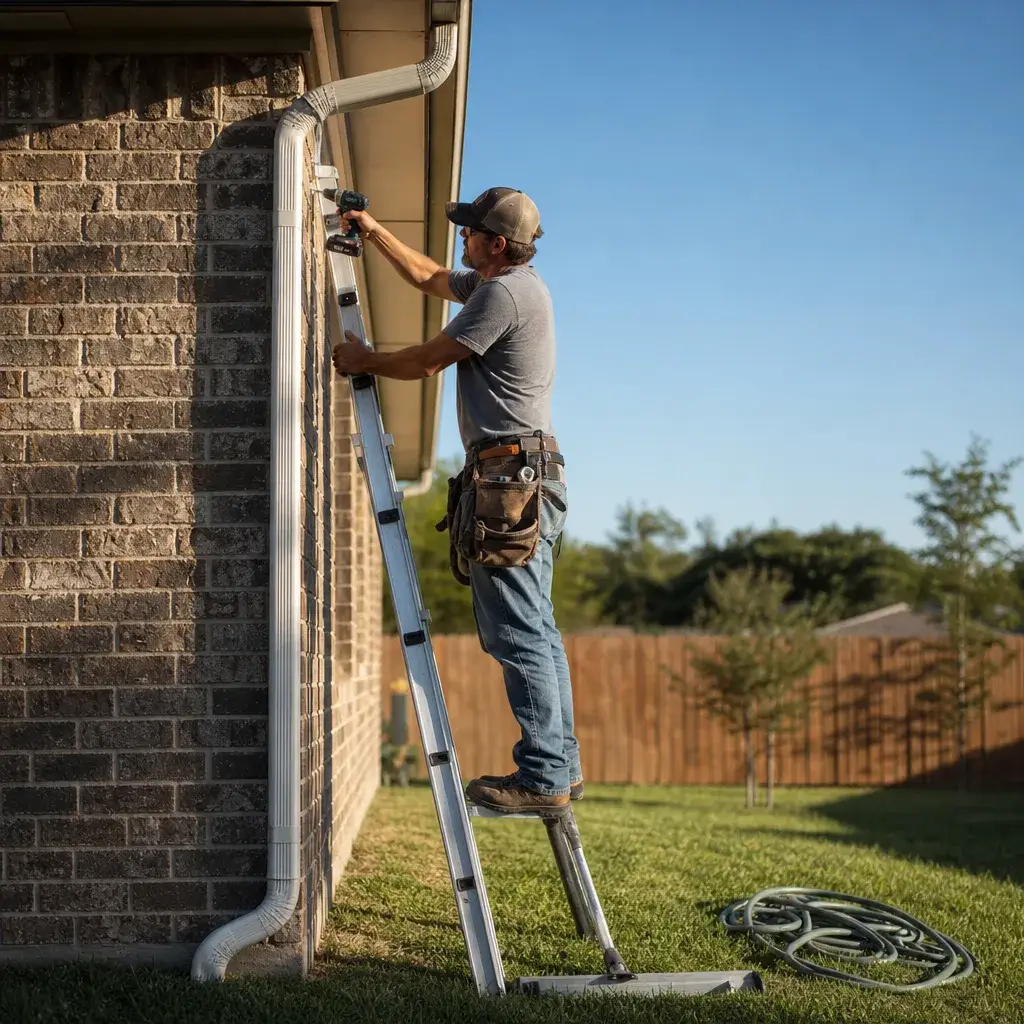
- How tall your house is. A one-story ranch needs a short run that someone can install from a ladder in the yard. A two-story home needs twice the pipe and more time up high, and that adds labor.
- How many downspouts you add. Each new one means a new hole cut in the gutter, a new outlet, new elbows, and new straps. Adding one to split a long run costs more than moving one, but it can fix a problem that upsizing can’t.
- What size you pick. Most homes have standard 2×3 inch downspouts. Larger 3×4 inch downspouts carry much more water and cost a bit more per foot. On a big roof, going larger can sometimes save you from adding extra downspouts.
- What they’re made of. Aluminum is the most common choice and matches most gutters. Heavier gauge metal holds up better when hail or a mower hits it. Copper costs far more and only makes sense if you have copper gutters or want that look.
- How far the water travels. A splash block is the simplest. A longer extension adds a little. A buried line adds the most, because someone has to dig a trench in dense clay, set the pipe at the right fall, and install an outlet in the yard.
- What turns up at the roofline. Soft fascia, gutters that are too small, or gutter outlets in the wrong spot have to be fixed before new downspouts will work. If your gutters are near the end of their life, replacing both at once can make more sense than paying to fit new downspouts onto old gutters.
Timing can help too. If you’re already planning gutter installation or a roof replacement, adding downspout work to the same project means one crew, one setup, and one cleanup instead of two separate jobs.
If a spring hailstorm crushed or dented your downspouts, that damage may be part of a storm claim along with your roof and gutters. It depends on your policy and what the adjuster finds. We’ll walk you through the claim, and you pay your deductible, nobody else. Financing is available for work insurance doesn’t cover.
When you compare bids, look for the same things on each one: the number of downspouts, the size and material, where each one empties, and any fascia or gutter work included. A low price that leaves out the extensions or skips the rotted fascia isn’t really lower. It just puts the water back at your slab, and you’ll pay to fix that later.
Frequently Asked Questions
Common questions about downspout installation in Sunnyvale, TX
Can pests get into my downspouts?
Yes, and it’s worth checking for them. Ants and other bugs like to nest under paving stones or splash blocks right where a downspout empties, since that spot stays damp. If you notice ant activity near a downspout outlet, lift the splash block or stone and look underneath before you assume the drainage itself is the problem.
Will a buried downspout drain line clog over time?
It can, especially in Sunnyvale’s dense clay soil where water doesn’t soak in fast. Leaves, roof grit, and silt can settle in a buried line if it doesn’t have enough fall to keep water moving. That’s why a buried line needs a clear outlet point in the yard where you can check that water is coming out after a storm.
Does hydro jetting apply to downspout drain lines?
Hydro jetting is a sewer line cleaning method, not something used on downspout drain lines. Downspout and yard drain lines are much smaller and are typically cleared with a hose or a simple snake, not high-pressure jetting equipment. If a buried downspout line is clogged, that’s a separate, smaller job than clearing a home’s sewer line.
Ready to Get Started?
Schedule Your Free Inspection. Call (972) 288-9587 today.