
Roof Leak Detection & Repair in Sunnyvale, TX
The real source of the leak found before anything is repaired – starting with a free inspection, not a guess at the stain on your ceiling.

What’s Covered on This Page
- Finding the Real Source of a Roof Leak Comes Before Any Repair
- Common Causes of Roof Leaks in North Texas Homes
- Signs Your Leak Needs Attention Now
- When a Stain Does Not Mean You Need Emergency Repair
- What Happens During a Roof Leak Inspection and Repair
- Do I need a permit to repair my roof leak in Sunnyvale?
- Can a leak around my chimney or skylight really show up somewhere else in the room?
- Will my homeowners insurance cover a roof leak caused by hail or wind?
- Should I worry if a solar installer or other contractor drilled holes in my roof and now it leaks?
Finding the Real Source of a Roof Leak Comes Before Any Repair
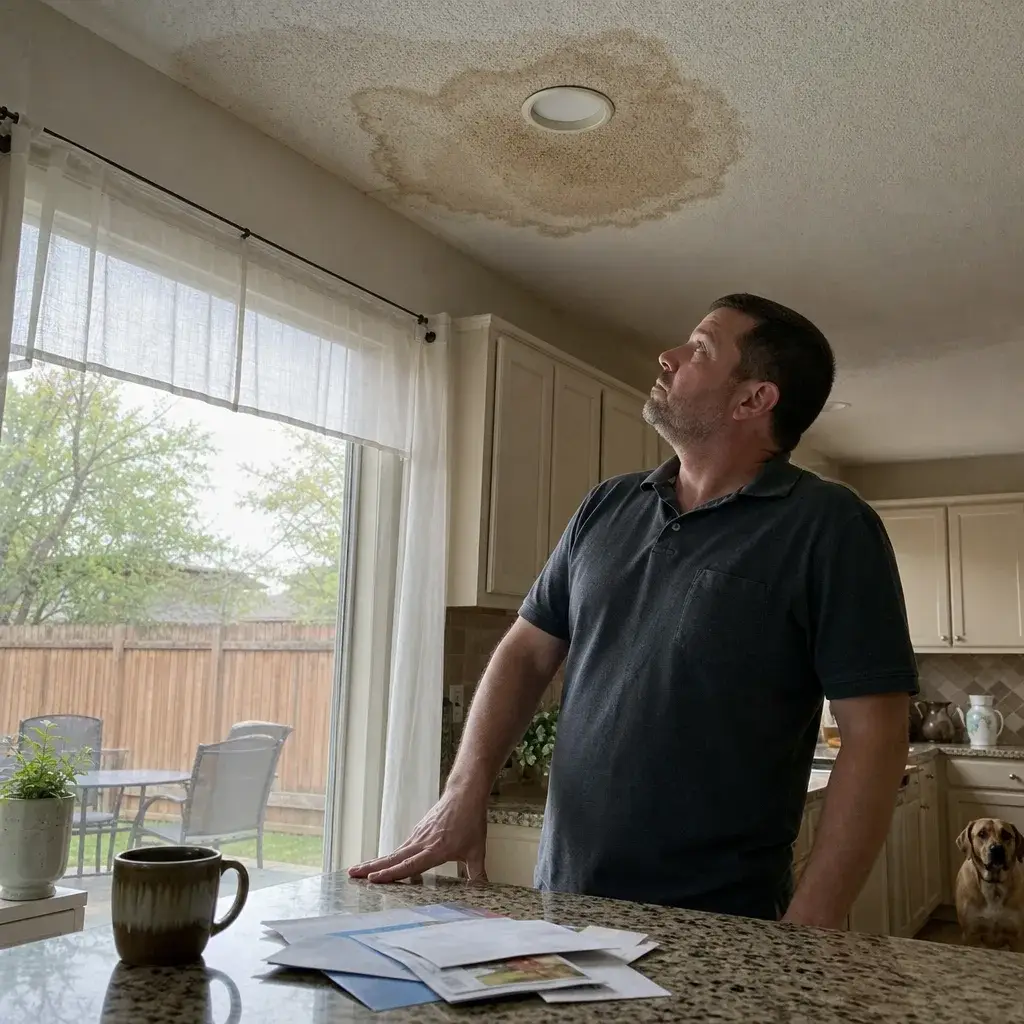
You found a brown ring on the ceiling, or you heard a drip in the hallway during last night’s storm. Your first thought is probably, “Just fix the roof right above it.” That’s where roof leak detection & repair gets tricky. Water doesn’t fall straight down. It slips in through one small gap, runs along the roof decking (the wood boards under your shingles) or down a rafter, and then drops onto your ceiling. Where it lands can be several feet from where it came in.
That’s why the repair only works if someone finds the real source first. A patch over the wrong spot looks fine on the day it goes on. Then the next hard rain comes, the stain comes back, and you’ve paid twice. Meanwhile water keeps soaking the wood you can’t see.
On homes around Sunnyvale and across North Texas, leaks tend to start in a handful of places:
- Pipe boots. These are the rubber collars around the vent pipes on your roof. Hundred-degree summers and strong UV can dry them out until they crack.
- Flashing. This is the thin metal that seals the joints around chimneys, skylights, and the spots where a roof meets a wall. Two-story homes have more of these roof-to-wall joints, so there are more places for water to sneak in.
- Valleys. Water from two roof slopes runs into these low seams, so a small flaw there gets tested hard in every storm.
- Hail and wind damage. Spring hail, roughly March through June, can bruise shingles in ways you can’t see from the yard. Straight-line winds can lift a shingle edge just enough to let rain blow underneath.
- Nail pops. These are roofing nails that work loose and push up through the shingle above them.
Sometimes the water isn’t coming from the roof at all. Gutters that overflow behind the fascia board can leave stains that look like a roof leak near an outside wall. So can water getting in around a window or through siding at the gables. If nobody checks for these, you could end up paying for roof work you didn’t need.
You can help narrow it down before anyone comes out. Take a photo of the stain each time it grows. Notice when the leak shows up. Does it drip only in heavy, wind-driven rain from one direction, every time it rains, or a day or two after a storm? Is it near a bathroom vent pipe, a chimney, or an outside wall? Little details like these point straight to the likely cause.
This is where a free inspection and an honest opinion matter more than a fast patch. ERO DFW is headquartered right here in Sunnyvale, and we respond to every inspection request within 24 hours. We’ll explain what we find and what your options are. You’ll get a written estimate before you sign anything, so you know you’re paying to fix where the water really gets in.
Common Causes of Roof Leaks in North Texas Homes
You already know where water usually gets in. The bigger question is why that spot gave up on your roof. Weather, age, and the way your house was built all play a part. Knowing the cause tells you whether you’re looking at a small repair or the start of a bigger conversation.
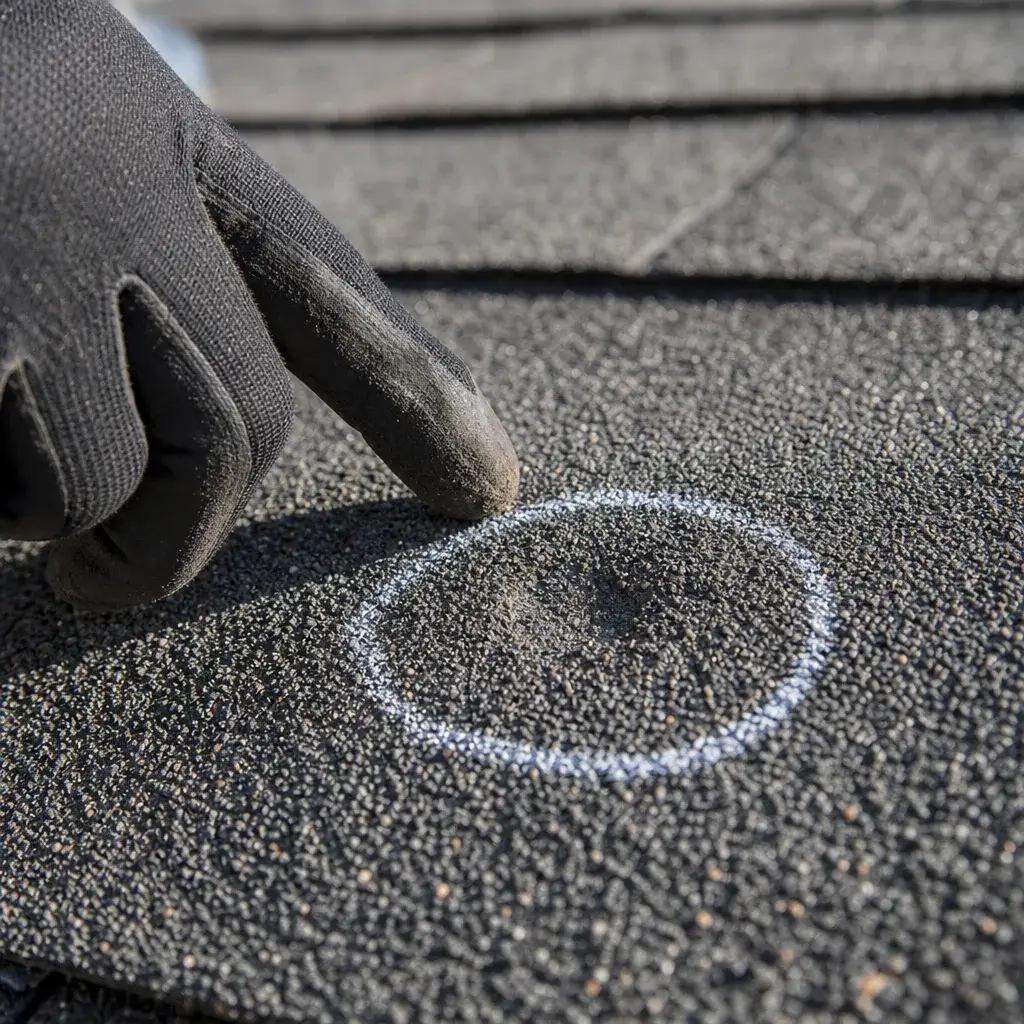
Age and sun wear. Shingles are covered in tiny granules that shield them from the sun. North Texas summers bake those granules loose a little at a time. You’ll find them in your gutters or at the bottom of your downspouts. Once the shingles get thin, a 15- to 20-year-old roof can start leaking in more than one place. Fixing one spot won’t fix the others. When that happens, an honest roofer should tell you so and talk with you about whether repair still makes sense.
Old quick fixes. A glob of roofing tar or caulk over a problem spot can hold for a season. Then the heat dries it out and it cracks. If a past owner or a fast-moving crew patched your roof that way, the leak may simply be coming back. The real fix is to replace the worn part, such as a cracked pipe collar or a bent piece of flashing, not to add more goop on top.
Ice storms. They don’t come often here, but when they do, ice can build up along the roof edge and in the valleys. As it melts, the water has nowhere to drain. It backs up under the shingles. A leak that shows up only after a freeze, near an outside wall, points to this.
Attic moisture that isn’t a leak at all. If your attic doesn’t breathe well, warm, damp air from the house can collect on the underside of the roof deck and drip back down. Drips on a dry day or on a cold morning, with no rain in sight, often mean a roof ventilation problem, not a hole in the roof.
Skylights. The flashing around a skylight can fail. So can the seal on the skylight itself. Water running down the inside of the glass or the frame usually means a worn seal. A stain on the ceiling next to the skylight points more toward the flashing outside.
Leaves and debris. Leaves and twigs pile up in valleys and gutters. The water slows down, spreads sideways, and finds seams it would normally run right past.
Your home’s style matters too:
- Older 1960s to 1980s ranch homes often still have their original vent pipe collars. Many also have a room addition or a patio cover tied into the main roof. The joint where the old roof meets the new one is a common weak spot.
- Larger two-story homes in newer subdivisions have long stretches where a lower roof runs into a brick or siding wall. If the small piece of flashing at the bottom of that joint is missing, it can’t steer water into the gutter. Water then runs down inside the wall, and the stain shows up far below the roof.
- Brick homes with siding at the gables can let wind-driven rain in where the siding meets the roof line. From inside the house, that can look exactly like a roof leak.
Match what you’re seeing to these causes and you’ll walk into the inspection already knowing the right questions to ask.
Signs Your Leak Needs Attention Now
Not every stain is an emergency. Some leaks can sit for a few days while you get an inspection on the calendar. Others get worse with every hour of rain. Here’s how to tell which one you’ve got.

Call right away if you notice any of these:
- Water is actively dripping or running. If you’ve got a bucket under it right now, water is getting past the roof and soaking the wood and insulation on its way down.
- The ceiling is sagging, bulging, or looks like a bubble. That usually means water is pooling above the drywall. Keep people and pets out from under it and move what you can out of the way.
- Water is near a light fixture, ceiling fan, or outlet. Stay clear of it and get help fast.
- A section of shingles is missing or a tree limb came down on the roof. After a straight-line wind or a spring hailstorm, an open spot can let in a lot of water during the next storm.
- The stain is growing each time it rains. A ring that spreads after every storm tells you the source is still open and the damage behind it is still spreading.
When a hole is open and more rain is coming, the first job is often just covering it. Emergency roof repair and tarping keeps water out until the real repair can be done right in dry weather.
Some signs aren’t an emergency tonight, but they shouldn’t wait long either. A musty smell in a closet or upstairs room can mean water has been getting in slowly for a while. Dark spots or fuzzy growth near a stain are a reason to have it looked at soon. Drywall that feels soft when you press it near the stain points the same way. So does daylight showing through the roof boards when you look up in your attic. Two or more stains in different rooms often mean an older roof wearing out in more than one place.
Timing matters here too. In Sunnyvale, spring brings hail and heavy storms one after another, roughly March through June. A small leak you notice in March can get tested again and again before summer. A leak that’s only a nuisance in a light shower can turn into real water in a hard, wind-driven rain.
Now the honest part. If you’ve got an old, dry stain that hasn’t changed in months, the ceiling feels firm, and nothing drips in heavy rain, you probably don’t need anyone out in a rush. That stain may be from a leak someone already fixed, maybe even before you bought the house. Take a photo, mark the edge lightly with a pencil, and check it after the next few storms. If the line stays put, you can schedule an inspection at a time that works for you. If it moves past the mark, it’s time to call.
Whichever group you’re in, you don’t need to decide on a repair today. You only need to know whether water is still getting in. Since we answer every inspection request within 24 hours, you won’t be left waiting through the next storm wondering.
Need help with your roof leak repair project?
Schedule Your Free Inspection. Exteriors, Roofing & Outdoor Living is ready to help.
When a Stain Does Not Mean You Need Emergency Repair
Some stains mean you don’t need a roofer at all. Others mean you need one, just not tonight. Here’s how to tell, even if it means you never call us.
Start with what’s above the stain. On a two-story home, a stain on the downstairs ceiling might have nothing to do with the roof. There’s a whole floor between it and the shingles. Look at what sits right above it. If the stain is under an upstairs bathroom, try a quick test. Have someone run the shower or fill the tub, then check the spot over the next hour or two. If it darkens on a dry, sunny day, the water is coming from inside the house. That’s a plumbing call, not a roof call.
The same goes for a stain that shows up in the middle of a July heat wave with no rain for weeks. Many North Texas homes have an air conditioner sitting in the attic. When its drain backs up, water can drip onto the ceiling below. That’s a job for the company that services your AC, not a roofer.
Here are a few other cases where you can slow down:
- The leak showed up once, during one unusual storm with rain blowing sideways, and hasn’t come back through several normal rains since. That’s still worth a look on your own schedule, but it isn’t an emergency.
- The roof was already repaired and you’re only looking at the old mark it left behind. If the spot stays dry and firm through a few storms, what’s left is cosmetic.
- The stain is small, dry, and sits right under an attic access hatch or a spot where someone stored boxes. Sometimes a past spill or a careless step in the attic leaves a mark that looks like a leak.
If what’s left is only cosmetic, you can often handle it yourself. Let the area dry out completely. Then cover it with a stain-blocking primer before you paint. Regular ceiling paint alone tends to let a water ring bleed back through. If the drywall is cracked or crumbling and needs patching, that’s a separate drywall repair job. It isn’t a roof repair.
Watch for anyone who tries to turn a dry, faded stain into a crisis. After a big storm rolls through Sunnyvale and the rest of Dallas County, crews often go door to door. Some will point at an old ceiling mark and say you need a new roof today, or that their price is only good if you sign now. A real leak doesn’t need a same-day signature. Neither does a stain that isn’t a leak.
A trustworthy roofer will tell you when the answer is “nothing yet” or “that’s not your roof.” If someone can’t explain where the water is coming from, they can’t fairly tell you what it’ll cost to stop it. When nothing is dripping, sagging, or spreading, you have time. Use it to get a clear answer before you agree to any work.
Watch Our Video
See How We Handle Roof Leak Detection & Repair in Sunnyvale, TX
Exteriors, Roofing & Outdoor Living — Serving Sunnyvale, TX and surrounding areas
What Happens During a Roof Leak Inspection and Repair
You’ve decided the leak is real. Now you want to know what happens when someone shows up, and how you’ll know they found the actual source and not just the wet spot.
A careful leak inspection looks at your home from three angles and lines them up:
- Inside the room. Where the stain sits, how big it is, and whether the drywall is soft. This is the clue, not the answer.
- In the attic. This is where the trail usually shows. Dark streaks on the roof boards, wet or matted insulation, rusty nail tips, or a pinhole of daylight can show where the water really came in and which way it ran before it dropped.
- On the roof. The parts above that trail get a close look, including the pipe collars, flashing, valleys, and any shingles that are bruised, lifted, or missing.
When the attic trail and the roof flaw point to the same spot, you’ve found your source. If they don’t match, a good roofer keeps looking. That may mean checking the gutters, the siding at the gables, or the joint where a lower roof meets a wall. Sometimes it means running water over one section of roof at a time while someone watches the attic. It’s slower than slapping tar on the closest shingle, but it’s how you avoid paying for the same leak twice.
At ERO DFW, that first visit is free. One of our sales managers looks over your home, explains what they found in plain English, and walks you through your options. Some fixes are small, like replacing one cracked pipe collar. Some need more, like resealing flashing along a wall or replacing a section of wet roof boards. You’ll get a written estimate before you sign anything. If what we find isn’t a roof problem, we’ll tell you that too.
Once you approve the work, a project manager takes it from there. They order the materials, set the schedule, and handle any permits or HOA approvals the job needs. They’ll keep you posted along the way. If a storm caused the damage and you’ve filed a claim, your project manager can meet with the insurance adjuster too.
On repair day, our roofers do the work, protect your property while they’re at it, and clean up when they’re done. In North Texas, that also means watching the sky. A repair goes on best in dry weather, so if spring storms are stacking up, covering the opening first and doing the full repair on a dry day can be the smarter order.
The job ends with a final walkthrough. You see what was fixed and ask anything you want before anyone calls it finished.
The real test comes later, with the next hard rain. Check the attic and that old ceiling spot afterward. If you marked the stain’s edge in pencil like we suggested earlier, you’ll know right away whether it’s dry and holding. A dry ceiling after a Sunnyvale downpour is how you know the source was found and fixed, not just covered up.
Frequently Asked Questions
Common questions about roof leak detection and repair in Sunnyvale, TX
Do I need a permit to repair my roof leak in Sunnyvale?
A small leak repair, like replacing a pipe boot or resealing flashing, usually doesn’t need a permit. Larger jobs, such as replacing a section of roof decking or a full tear-off, often do. You can check requirements with the Town of Sunnyvale permit portal before work starts, and we can help confirm what your specific repair needs.
Can a leak around my chimney or skylight really show up somewhere else in the room?
Yes, water almost never drips straight down from where it enters. It can run along the roof decking or a rafter for several feet before dropping onto your ceiling. That’s why checking the attic for the actual trail matters more than just looking at the stain itself.
Will my homeowners insurance cover a roof leak caused by hail or wind?
It depends on the cause and your policy, so it’s worth checking with your insurer and the Texas Department of Insurance for guidance on your coverage. Storm damage from spring hail or straight-line winds is often covered, while a leak from age or wear typically isn’t. A written inspection report showing where the water entered gives you solid documentation to bring to an adjuster.
Should I worry if a solar installer or other contractor drilled holes in my roof and now it leaks?
Yes, any holes drilled into your roof deck for mounts or equipment can become leak points if they aren’t sealed correctly. This is a common complaint with solar installs. A roof inspection can confirm whether the leak is coming from those penetrations so you know exactly what needs fixing.
Ready to Get Started?
Schedule Your Free Inspection. Call (972) 288-9587 today.