
Skylight Repair in Sunnyvale, TX: Repair It or Replace It?
Leaking skylights traced to the real cause and repaired, or replaced when they have to be – starting with a free inspection.
What’s Covered on This Page
- Repair or Replace: How the Decision Gets Made
- Signs Your Skylight Leak Started in the Flashing, Not the Glass
- When Storm Damage Is the Real Cause
- What Happens During a Skylight Inspection and Estimate
- When a Skylight Does Not Need Professional Repair
- How long does a typical skylight repair take?
- Can I repair a skylight leak myself?
- Will my skylight leak get worse if I wait to fix it?
Repair or Replace: How the Decision Gets Made
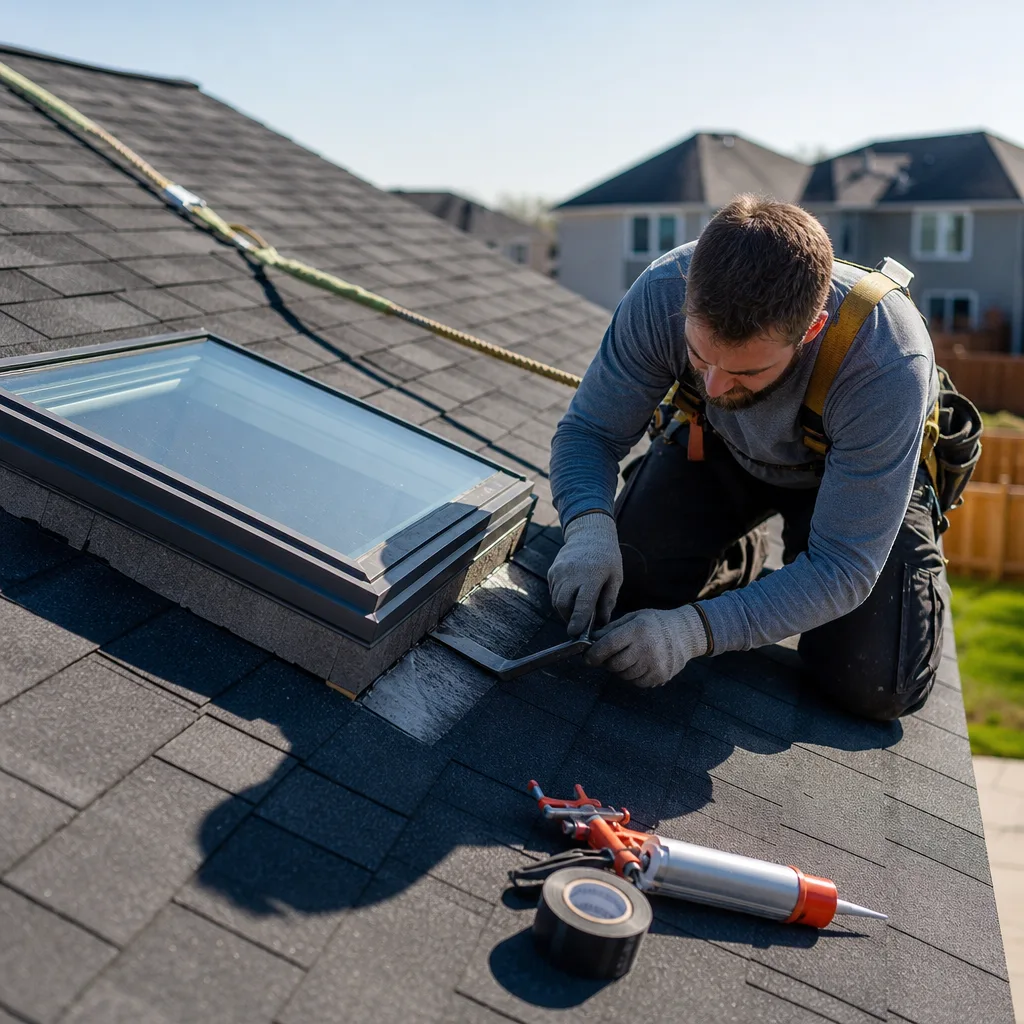
Think of a skylight as two parts. There’s the window you look through, and there’s everything that ties it into your roof. That second part includes the flashing, which is the thin metal that sheds water around the edges, the sealant, and the curb, the raised wood frame the skylight sits on. Many leaks start in that second part. A repair there can stop the water without touching the skylight at all.
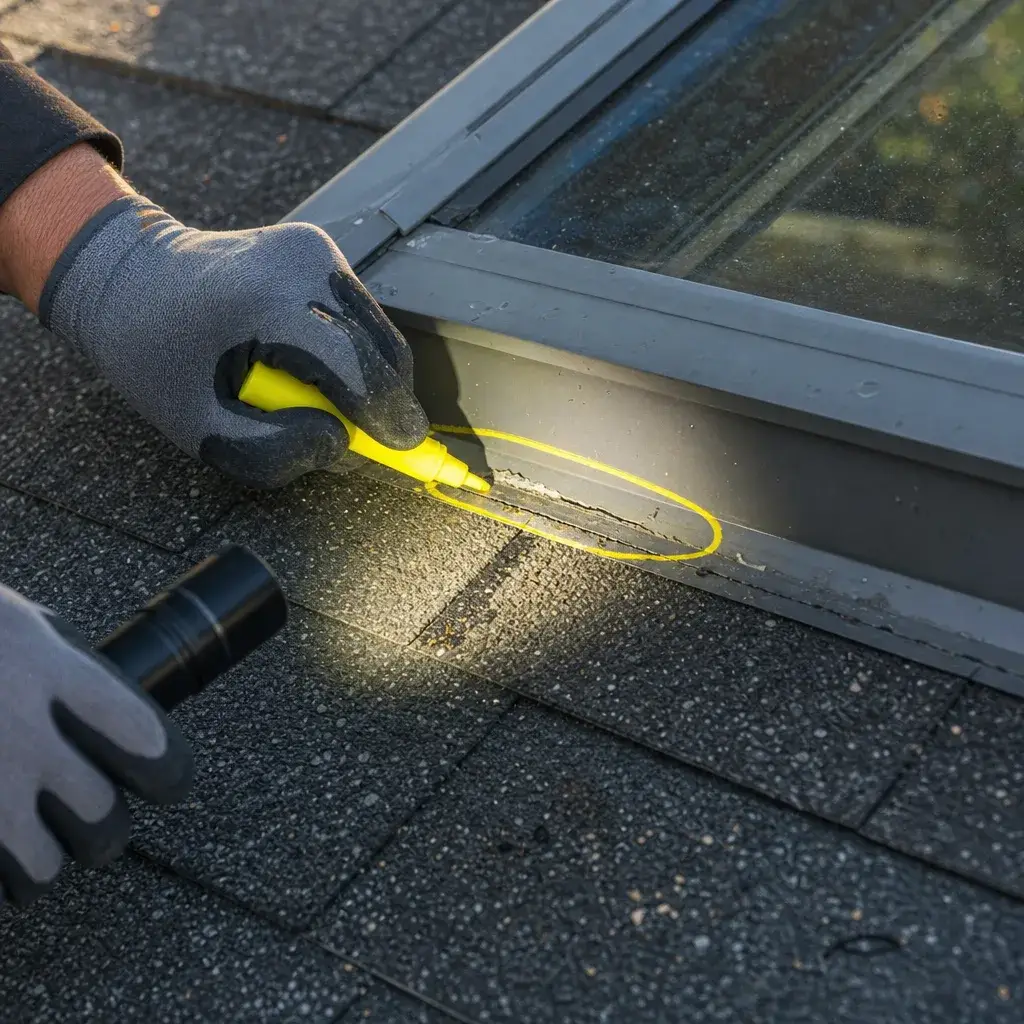
Repair is usually the right call when:
- Water shows up only during hard, wind-driven rain, which often points to a flashing gap rather than a failed unit.
- The sealant around the edges is cracked or pulling away, but the glass or dome is clear and solid.
- One section of flashing was bent or lifted by wind, and the rest of the skylight is in good shape.
- The skylight is fairly new and your roof still has plenty of life left.
Replacement usually makes more sense when:
- A plastic dome has turned yellow, cloudy, or brittle. Years of North Texas summer sun and heat break down older plastic domes, and once they crack, patching rarely holds.
- Double-pane glass looks foggy between the panes. That means the seal between the two layers has failed, and the unit can’t be resealed from the outside.
- The curb or the wood around the opening is soft or rotted from a slow leak that went unnoticed.
- You’ve had the same skylight repaired before, and it’s leaking again.
- Hail cracked the dome or glass. Spring storms here, roughly March through June, can break a skylight just as easily as they bruise shingles.
Your roof’s age matters too. Many 1960s to 1980s ranch homes and older two-story homes have skylights as old as the roof around them. If your shingles are close to the end of their life, putting a new skylight in at the same time as a new roof is often smarter than fixing the old one now. Tearing into the same spot again in a few years costs more in the end. The reverse is also true. If your roof is only a few years old, there’s rarely a good reason to disturb it more than you have to.
If a storm caused the damage, it may be part of an insurance claim along with the rest of your roof. We’ll walk you through the claim, and you pay your deductible, nobody else.
Here’s what you should expect from any honest contractor. They should show you where the water is getting in and tell you whether the problem is the skylight or the roof around it. Then they should put their recommendation in writing. At ERO DFW, the inspection is free, and you get a written estimate before you sign anything. If a repair will do the job, that’s what you should hear from us, even when a replacement would be the bigger ticket.
Signs Your Skylight Leak Started in the Flashing, Not the Glass
You can learn a lot before anyone sets a ladder against your house. Where the water shows up, when it shows up, and what it looks like all point toward the source. Everything below is something you can check from inside your home or from the yard.
These clues usually point to the flashing or sealant around the skylight:
- The stain is on the walls of the light shaft, the short drywall tunnel between your ceiling and the skylight, and not on the glass itself.
- Water shows up at a corner, most often the upper corner on the uphill side of the roof. That’s where rain running down the roof hits the skylight first.
- There’s a ceiling stain a foot or two away from the skylight. Water can travel along the wood before it drips, so the spot you see isn’t always right under the gap.
- It leaks in heavy downpours but stays dry in a light shower.
- From the yard, you can see bent, lifted, or rusty metal at the edges, or shingles around the skylight that are curled, cracked, or missing.
- There are thick black tar patches around the skylight. That usually means someone has already tried a quick fix, and the real gap may still be under it.
- Leaves and debris pile up on the uphill side. That little dam holds water against the edge long after the rain stops.
North Texas weather adds a few of its own clues. Straight-line winds can lift one edge of the flashing, so a leak that only shows up when a storm blows in from one direction is worth noting. During the occasional ice storm, ice can build up on the uphill side and push melting water back under the edges, even on a skylight that’s dry the rest of the year.
These clues point to the skylight itself:
- Water drips from one spot in the middle of the glass or dome, right under a visible crack.
- You can see a crack, a chip, or a hail dent in the dome.
- The frame of the unit is cracked or pulling apart at the corners.
Before you assume the worst, rule out condensation. If you see drops on the inside of the glass on a cold winter morning and it hasn’t rained, that’s probably not a leak. Warm, moist air from your kitchen, bathroom, or showers hits cold glass and turns to water, the same way a cold glass of iced tea sweats on a July afternoon. Condensation tends to cover the glass evenly and dries up as the day warms. A leak shows up after rain and leaves a stain that stays.
Keep a simple record each time you notice water. Write down the date, how hard it was raining, which way the wind was blowing, and snap a photo of the stain. That record helps whoever inspects your roof find the source faster. If a storm caused the damage, those dated photos are also useful when you file an insurance claim.
If your clues point to the flashing, that’s often good news. As covered above, a gap around the skylight can usually be fixed without replacing the skylight itself.
When Storm Damage Is the Real Cause
Some skylight leaks build slowly over years. Others start the night a storm rolls through. If your skylight was dry all last year and started leaking after spring hail or a hard wind, the storm is the first thing to look at. That matters for more than the repair. Storm damage is the kind of damage homeowners insurance is usually written to cover. Normal wear and old age usually aren’t covered.
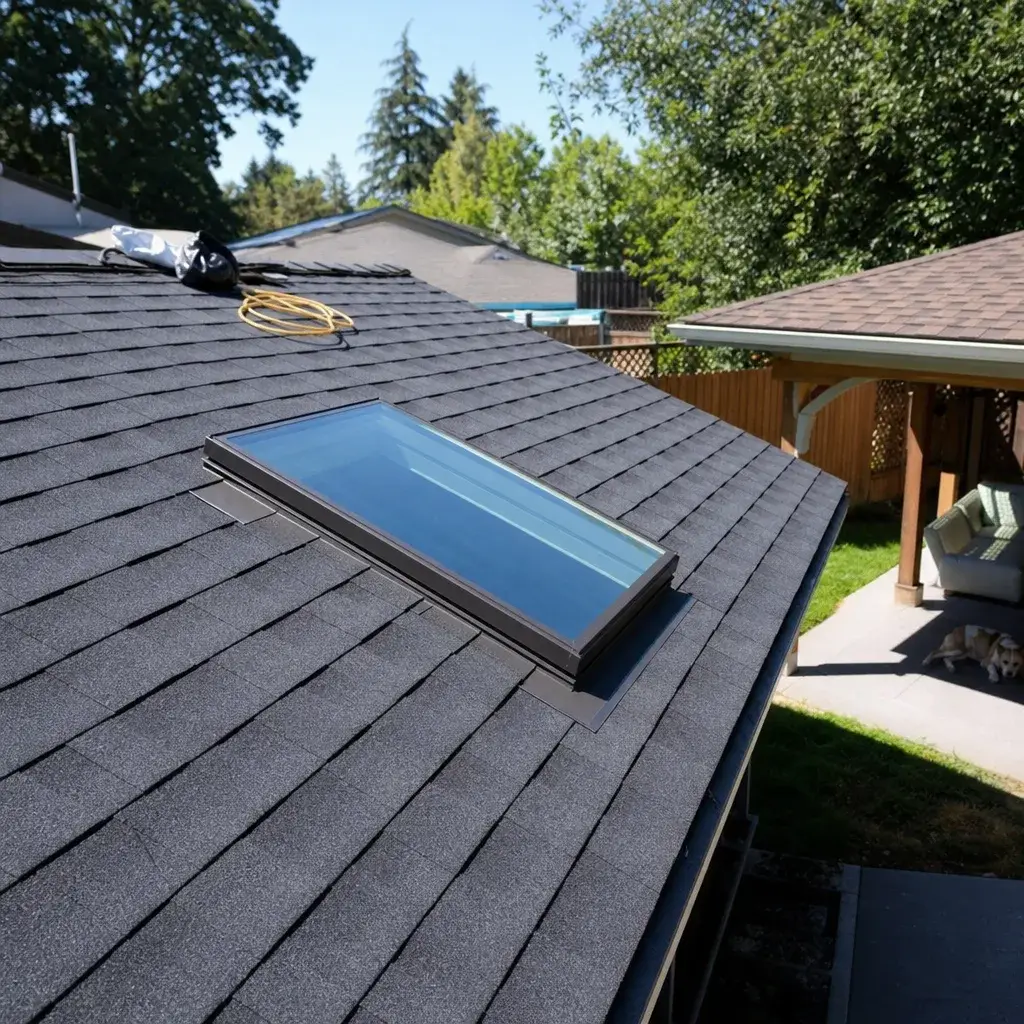
Storm damage to a skylight isn’t always obvious. Hail can leave a hairline crack in a plastic dome that doesn’t drip until the next big rain. Straight-line winds can lift the flashing just enough to let water in sideways. A falling branch can knock the frame loose. Hail that bruises the shingles around the skylight can open a path for water, too. That’s why a skylight should be checked as part of the whole roof after a storm, not on its own. If hail hit your skylight, it probably hit your roof as well.
Here’s what to do in the first few days:
- Stay off the roof. Wet shingles and a cracked skylight are a bad mix for anyone without the right gear.
- Move furniture and rugs out from under the drip and set out a bucket or towels.
- If water is coming in steadily, ask for emergency tarping. A tarp keeps the rain out until the real repair can be done.
- Get the roof and skylight inspected before you file. Then you know whether there’s real storm damage worth a claim.
- Check your policy for its deadline to report damage. Policies set their own time limits, so don’t let weeks slip by.
If you do file, your insurance company will send an adjuster to look at the damage. At ERO DFW, our project manager can meet the adjuster at your home, so the person who inspected your skylight is there to point out what the storm did. We’ll walk you through the claim one step at a time. We can’t promise what your insurer will approve, and nobody honest can. What we can promise is that you’ll understand each step before it happens.
About your deductible: in Texas, you’re expected to pay it, and a contractor isn’t allowed to waive it or quietly cover it for you. If someone offers to “take care of your deductible,” that’s a red flag, not a favor.
Watch for that offer, because after a big hailstorm east of Dallas, the knocks on the door come fast. A crew with out-of-state plates may promise a new skylight by Friday and be gone before your warranty question comes up. Before you sign with anyone, ask a few simple questions. Where is your office? Will I get a written estimate before I sign anything? Are you licensed, bonded, and insured?
Our answers are easy to check. ERO DFW is family-owned and has been serving North Texas since 2019. We’re headquartered right here in Sunnyvale on the U.S. 80 frontage road, with ten local offices across the Metroplex. We’re licensed, bonded, and insured, and we respond to every inspection request within 24 hours.
Proudly serving Sunnyvale, TX – reach out anytime.
Schedule Your Free Inspection. Exteriors, Roofing & Outdoor Living is ready to help.
What Happens During a Skylight Inspection and Estimate
When you call ERO DFW, a sales manager gets back to you within 24 hours to set up your free inspection. The goal of that visit is simple. Find out where the water is really getting in, so you only pay to fix the part that failed.
A thorough skylight inspection should look at both halves of the problem, the skylight itself and the roof around it. Here’s what a careful inspector checks:
- The flashing on all four sides, with extra attention to the uphill edge where rain hits first.
- The sealant at the edges, looking for cracks, gaps, or old tar patches hiding a problem.
- The shingles or tiles right around the curb, since a damaged shingle can let water in beside a perfectly good skylight.
- The dome or glass, checking for cracks, hail marks, yellowing, or fog between the panes.
- The light shaft and ceiling inside, matching the stains you’ve seen to what’s going on above them.
If you kept dated notes and photos of the leak, have them ready. They can save time and point the inspection in the right direction.
Your written estimate should answer three questions plainly. Where is the water coming in? Should this be a repair or a replacement, and why? What exactly is included? If the estimate just says “replace skylight” with no reason given, ask for one. You should be able to read it at your kitchen table and understand what you’re paying for.
There’s no single price for skylight repair, because a few things change the size of the job:
- Whether only the flashing or sealant needs work, or the whole unit has to come out.
- How hard the skylight is to reach. A steep roof or a second-story skylight takes more time and safety gear.
- Your roofing material. Tile and metal take more care to open up and close back up than standard shingles.
- Hidden rot in the curb or the wood around the opening, which has to be replaced before anything goes back on top.
- Water damage inside, like stained or soft drywall in the light shaft.
That last one is where having one team helps. ERO DFW handles drywall repair too, so the stain in your light shaft doesn’t mean calling a second contractor. It’s the roof over it and the rooms in it, fixed by the same people. Financing is available if you need it.
If you decide to go ahead, a project manager takes it from there. They order materials, set the schedule, handle any permits the job needs, keep you updated, and do the final walkthrough with you. Our crews protect your home while they work and clean up before they leave.
Watch Our Video
See How We Handle Skylight Repair in Sunnyvale, TX
Exteriors, Roofing & Outdoor Living — Serving Sunnyvale, TX and surrounding areas
When a Skylight Does Not Need Professional Repair
Not every drip, stain, or odd sound around a skylight means you need a roofer. Some things are normal. Some are cleaning jobs. And a few are worth waiting on. Here’s the honest list.

You probably don’t need a repair if any of these match what you’re seeing:
- Drops show up on cold mornings with no rain, then dry by lunch. That’s the condensation we covered above, not a leak. Running your bathroom fan during and after showers, and your kitchen vent while you cook, often cuts it down a lot.
- The dome looks dull or dusty from the yard. North Texas dust and spring pollen settle on skylights the same way they settle on your car. A good rain usually rinses most of it off. Dust is dirt sitting on top. Yellowing is the plastic itself breaking down, and that’s a different story.
- The light shaft looks dingy, or bugs have collected along the inside edge. That’s a cleaning job you can do from a stepladder inside your home. Wipe the inside of the glass or dome gently with a soft cloth.
- A plastic dome ticks, pops, or creaks as the day heats up or cools down. Plastic grows and shrinks with temperature. On a day that swings from a cool morning to a hot afternoon, that noise is normal as long as no water follows it.
- The room gets hot in July. That’s sunlight doing what a skylight lets it do, not a defect. An interior shade can take the edge off without anyone touching your roof.
An old stain is another common worry. Maybe it was there when you bought the house, or it’s left over from a leak that was already fixed. Here’s a simple test. Trace the edge of the stain lightly in pencil. Then watch it through the next few good rains. If it doesn’t grow, darken, or feel soft, the leak behind it is likely gone. What’s left is a paint and drywall touch-up, not a roof repair.
If the stain does grow past your pencil line, or the drywall feels soft or spongy, that’s water still getting in. Go back to the clues in the earlier sections and have it looked at.
Sometimes the right move is to wait. Say the sealant around your skylight shows a small crack, but nothing’s leaking. And your roof is already near the end of its life, with a replacement planned in the next year or so. In that case, it often makes sense to hold off and handle the skylight when the new roof goes on. You’ll open up that part of the roof once instead of twice. Just keep checking the ceiling after big storms while you wait.
One thing to skip: smearing roof tar around the edges yourself. It can hide the real gap and make the next fix harder. It also means climbing onto a roof, and that’s not worth the risk for a skylight that isn’t actively leaking.
Frequently Asked Questions
Common questions about skylight repair in Sunnyvale, TX
How long does a typical skylight repair take?
Most flashing or sealant repairs take just part of a day once we know where the leak is coming from. A full skylight replacement takes longer, especially if the curb or wood underneath needs rebuilding. Weather and roof material also play a part, since steep roofs or tile take more time to open up and close back correctly.
Can I repair a skylight leak myself?
You can handle small checks yourself, like wiping condensation or cleaning dust off the dome, but climbing onto the roof to seal or patch flashing isn’t worth the risk. Smearing roof tar over a suspected leak can hide the real gap and make the next repair harder. If water is coming in after rain, it’s safer to have the flashing and curb checked by someone who can get up there safely.
Will my skylight leak get worse if I wait to fix it?
It depends on where the leak is coming from. A small flashing gap that only drips in heavy, wind-driven rain can sit for a while without much harm, but rot in the curb or wood frame gets worse every time it rains. If you’re already seeing soft or spongy drywall around the light shaft, that’s a sign water has been getting in long enough to cause real damage, and it’s worth having looked at soon.
Ready to Get Started?
Schedule Your Free Inspection. Call (972) 288-9587 today.