
Seamless Gutters in Sunnyvale, TX: What to Know Before You Replace Yours
Seamless gutters cut to fit your home and sized for your roof – starting with a free inspection that tells you if cleaning alone would solve it.
What’s Covered on This Page
- Seamless Gutters Explained: What You’re Buying
- Signs Your Gutters Need Replacing, Not Just Cleaning
- When Cleaning Alone Solves the Problem
- Choosing the Right Gutter Size for Your Roof
- What Happens on Installation Day
- How long do seamless gutters last?
- Can one company handle both leak repair and full replacement?
- Do seamless gutters come in different colors to match my trim?
- What’s the difference between seamless gutters and the sectional ones sold at hardware stores?
Seamless Gutters Explained: What You’re Buying
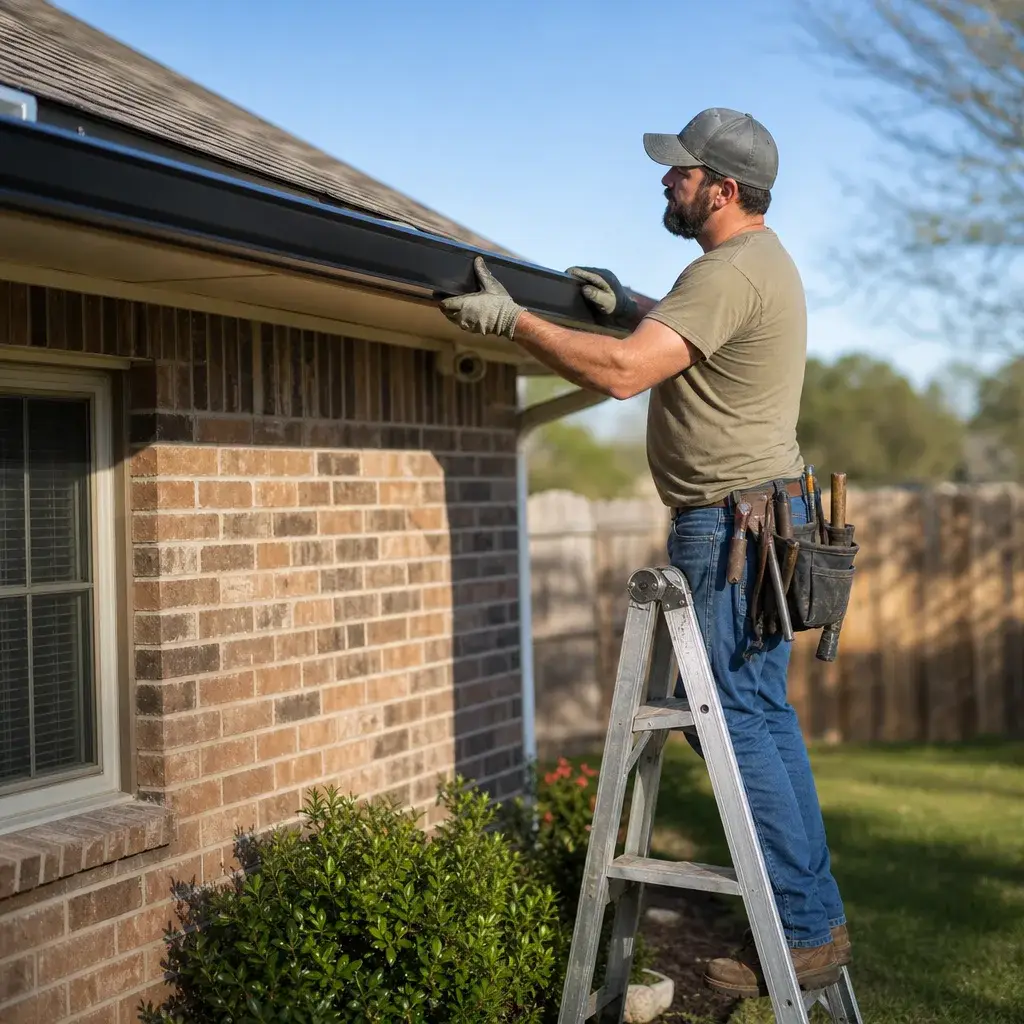
Seamless gutters are exactly what they sound like. Instead of snapping together short store-bought sections, the installer forms each gutter from a coil of metal to the exact length of that side of your house. One wall gets one piece. The only joints left are at the corners and where the downspouts drop.
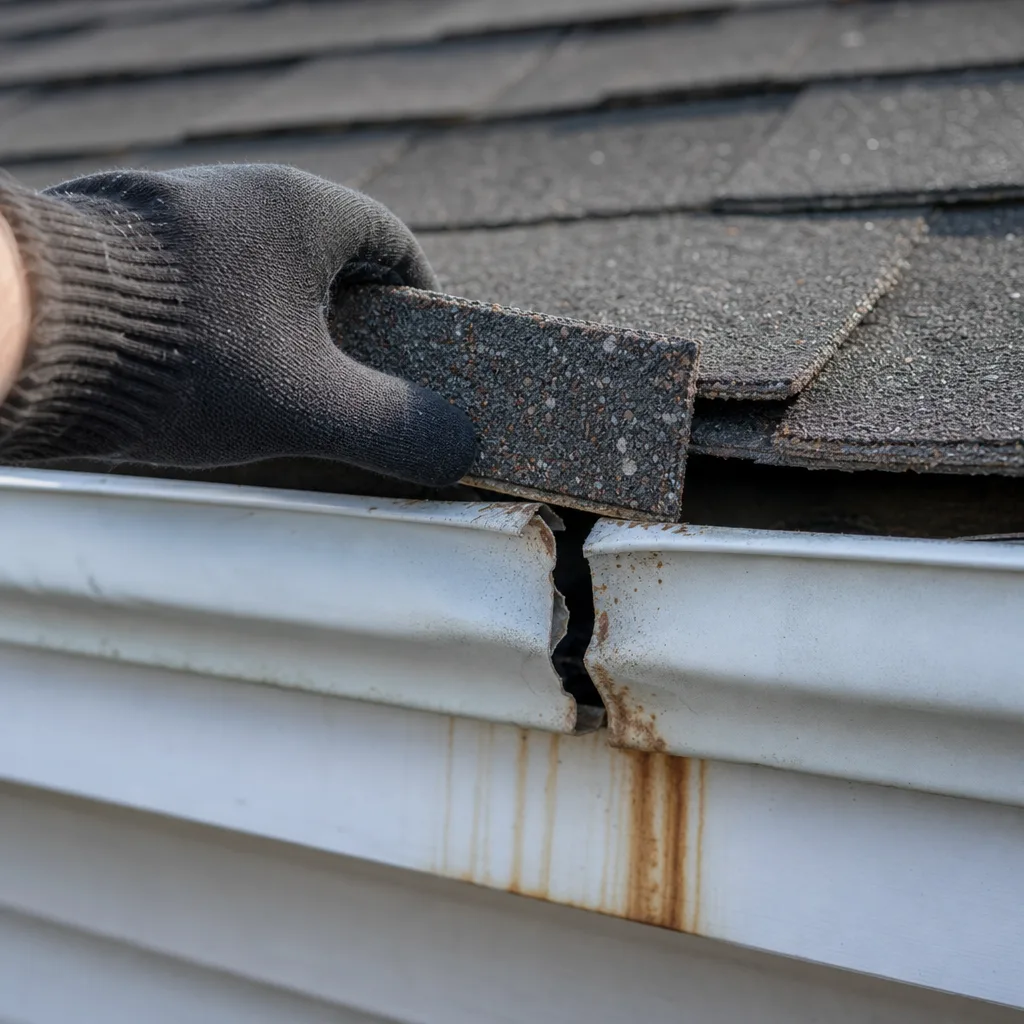
That matters because seams are where old gutters fail. Every joint is held by sealant, and North Texas heat bakes that sealant season after season until it cracks. Then you get drips at the joints, rust stains on the brick, and sections that sag. Fewer seams means fewer places for that to start.
Here’s the part most pitches skip. “Seamless” only describes the gutter. It doesn’t tell you whether the system will handle a spring downpour or put the water somewhere safe. When you buy seamless gutters, you’re really buying four things:
- The gutter size. Most homes use 5-inch or 6-inch gutters. A steep roof or a big roof section feeding one run may need the larger size, or water will shoot right over the front edge in a heavy storm.
- The hangers. These are the brackets that hold the gutter to your fascia, the trim board along the roof edge. Their spacing and strength decide whether the gutter stays put when it’s full of water or weighed down with ice.
- The slope. A gutter needs a slight, steady fall toward the downspout. Too flat and water sits there. Too steep and it overflows at the low end.
- The downspouts. How many there are, where they go, and how far they move water away from your home.
That last item is where Sunnyvale homes are different. Most houses here sit on a concrete slab, and the ground underneath is expansive clay. Clay swells when it’s soaked and shrinks when it dries out in August. A downspout that dumps a whole roof’s worth of water right at the corner of your slab keeps that soil cycling between wet and dry. Over time that can show up as erosion along the foundation or cracks you didn’t have before. A good gutter plan carries the water out past that zone so the soil around your slab stays more even.
Material is part of the choice, too. Most seamless gutters are aluminum because it’s light, it doesn’t rust, and it comes in colors that match your trim. Copper gutters and half-round gutters are also options if you want a different look, and each has its own page.
So when you compare bids, don’t stop at “seamless.” Ask what size they’re proposing, how the gutters will be hung, and where every downspout will empty. Those answers tell you whether you’re getting a gutter or a system that protects your house.
Signs Your Gutters Need Replacing, Not Just Cleaning
Not every overflowing gutter needs to come down. Plenty of gutter problems in Sunnyvale come from leaves, seed pods, and roof grit packed into the corners and downspouts. Clean those out and the gutter works again. So before you price out a new system, figure out which problem you have.
Cleaning or a small repair is probably all you need if:
- Water spills over the edge only after the trees drop leaves, and the gutters run fine once they’re cleared.
- One downspout backs up, and you can feel a clog when you push a hose up from the bottom.
- A single hanger has worked loose and one short stretch sags, but the rest of the run sits tight to the house.
- One corner drips, and the metal around it is still solid.
In those cases, a cleaning or a gutter repair is the honest fix. Replacing a sound system to solve a clog is spending money you don’t need to spend.
Replacement starts to make sense when the gutters fail even while they’re clean:
- The gutter is pulling away from the house in more than one spot, or the hangers won’t hold because the wood behind them has gone soft.
- Joints you’ve already resealed are leaking again, and new drips keep showing up at other seams.
- Water pours over the front edge in a hard spring storm when the gutter is empty. That usually points to a gutter that’s too small for the roof above it.
- Water sits in the gutter for days after a rain because the slope has flattened out or sagged.
- You see rust, holes, or split seams, or the metal is so dented that water pools in the low spots.
- The soil next to your slab keeps washing out, or mulch and gravel end up on the sidewalk after every rain, because the downspouts drop water in the wrong place.
Pay close attention to the board behind the gutter. That’s your fascia, the trim along the edge of the roof. When gutters leak or overflow for a long time, water soaks that board. You’ll see peeling paint, dark stains, or wood that feels spongy when you press it. If the fascia has rotted, new gutters can’t hang on it safely, so it gets fixed first. Fascia and soffit repair is its own job with its own page, but it’s worth knowing about before anyone quotes you just for gutters.
Hail is a special case in North Texas. After a spring storm, your gutters may show small dents along the top edge and the downspouts. Light dents on their own often don’t hurt how the gutter drains. Deep dents, crushed downspouts, or seams knocked loose are a different story. Either way, the dents are a good clue about what the hail did to your roof, so it’s smart to have the roof looked at too.
Here’s a simple test you can run yourself. Once the gutters are clean, run a garden hose on the roof edge at the far end of each run, or watch the next real rain. If the water flows to the downspout, drains out, and leaves the ground below dry, your gutters are likely still doing their job. If it spills over, drips at the seams, or sits in the gutter, the problem isn’t dirt. It’s the system, and that’s when seamless gutters sized and sloped for your roof are worth a look.
When Cleaning Alone Solves the Problem
If your gutters passed the checks above, you don’t need new ones yet. You need a good cleaning and maybe one or two small fixes. That’s the honest answer, even from a company that installs gutters.

A real cleaning is more than scooping leaves off the top. If you do it yourself or hire someone, make sure it covers these steps:
- Clear the corners and the area right above each downspout. That’s where debris packs the tightest.
- Flush every downspout all the way through. A gutter can look empty and still back up because the pipe below is plugged.
- Check the end caps and corner joints for drips once the water’s running.
- Look at what came out. A lot of gritty shingle granules in the muck is a roof question, not a gutter question, and worth having someone look at.
Timing matters in North Texas. Most trees here drop their leaves in late fall, so that’s a natural time to clean. Spring brings its own mess. Trees shed pollen strings and seed pods, and a hailstorm can strip leaves and twigs off the branches and dump them straight into your gutters. Cleaning after a big spring storm keeps the next downpour from overflowing a gutter that’s really just clogged.
A few low-cost fixes can keep older gutters working for years:
- Add a downspout extension or splash block. If water is pooling at the corner of your slab, moving it a few feet out may be all you need. On clay soil, that small change does a lot.
- Reseal one leaky corner. If the metal around it is solid, fresh sealant is a fair fix.
- Re-secure a loose hanger. One sagging stretch on sound fascia can usually be pulled back up and fastened.
- Trim branches that hang over the roof. Less debris going in means fewer clogs and less cleaning.
If you’re up on a ladder every few months because of a big tree over the house, gutter guards may be worth a look. They’re a cover that keeps most leaves out while letting water through. They’re an add-on, not a reason to replace gutters that still work.
There’s also a good case for waiting even when your gutters are getting old. If your roof is near the end of its life, hold off on new gutters for now. Gutters hang right at the roof edge, and a roof replacement often means taking them down or working around them. Keep the old ones clean and patched, and plan both jobs together so you only pay for that edge to be disturbed once.
The same goes if you just moved in and the gutters look rough from the street. Clean them first and watch a couple of rains before you decide. Plenty of gutters that look tired are just full.
Need help with your gutter project?
Schedule Your Free Inspection. Exteriors, Roofing & Outdoor Living is ready to help.
Choosing the Right Gutter Size for Your Roof
Gutter size isn’t about the size of your house. It’s about how much water hits each stretch of roof and how fast that water reaches the edge. Two homes on the same street can need different gutters, and one home can need different sizes on different sides.
These are the things that push a run toward the bigger size:
- How much roof drains into it. A long, wide roof section sends all of its water to one gutter. The more square footage that feeds a single run, the more that gutter has to carry.
- How steep the roof is. Water picks up speed on a steep roof. On a low-pitch ranch roof it rolls into the gutter. On a steep roof it can shoot past a small gutter’s front lip.
- Valleys. Where two roof slopes meet in a V, water from both sides funnels to one spot. The gutter right below a valley takes a heavy, focused stream, and it’s often the first place to overflow.
- An upper roof draining onto a lower one. On a two-story home, the top roof’s water often lands on the first-story roof and then runs into that lower gutter. That gutter is handling two roofs’ worth of rain.
North Texas weather matters here too. Spring storms don’t always bring a slow, steady rain. They can dump a lot of water in a short burst. A gutter that keeps up with a gentle shower can still spill over in a hard downpour, and that hard rain is what you’re sizing for.
In plain terms, a one-story brick ranch with a simple, low-pitch roof is often well served by 5-inch gutters. A larger two-story home, or one with steep pitches and several valleys, is a common candidate for 6-inch gutters on at least some runs. Mixing sizes on one house is normal. There’s no rule that every side has to match.
Don’t forget the downspouts. They’re the drain, and a big gutter can’t empty faster than its downspout lets it. Standard downspouts are 2 by 3 inches. Larger 3 by 4 inch downspouts move a lot more water and clog less often with leaves and seed pods. Sometimes the fix for an overflowing corner isn’t a bigger gutter at all. It’s a larger downspout or one more downspout on a long run.
Going bigger does cost more, because it takes more metal and sometimes sturdier hangers. That’s one reason bids can differ. A higher bid isn’t padded just because it calls for 6-inch gutters, and a lower one isn’t a bargain if it puts a 5-inch gutter under a valley that’s already overflowing today.
When you look over a bid, ask these questions:
- What size gutter is going on each side, and why that size?
- Which runs sit under a valley or an upper roof, and how are those handled?
- What size are the downspouts, and how many will each run have?
- Where does my home overflow now, and how does this plan fix that spot?
A good installer can answer every one of those while pointing at your roof. If the answer is just “we always use this size,” that tells you the gutters weren’t sized for your house.
Watch Our Video
See How We Handle Seamless Gutters in Sunnyvale, TX
Exteriors, Roofing & Outdoor Living — Serving Sunnyvale, TX and surrounding areas
What Happens on Installation Day
Most of the hard thinking happens before install day. The sizes, the downspout spots, and the hanger plan should already be settled in your written estimate. On the day itself, you’re mostly watching that plan become real. Here’s what to expect, so nothing catches you off guard.
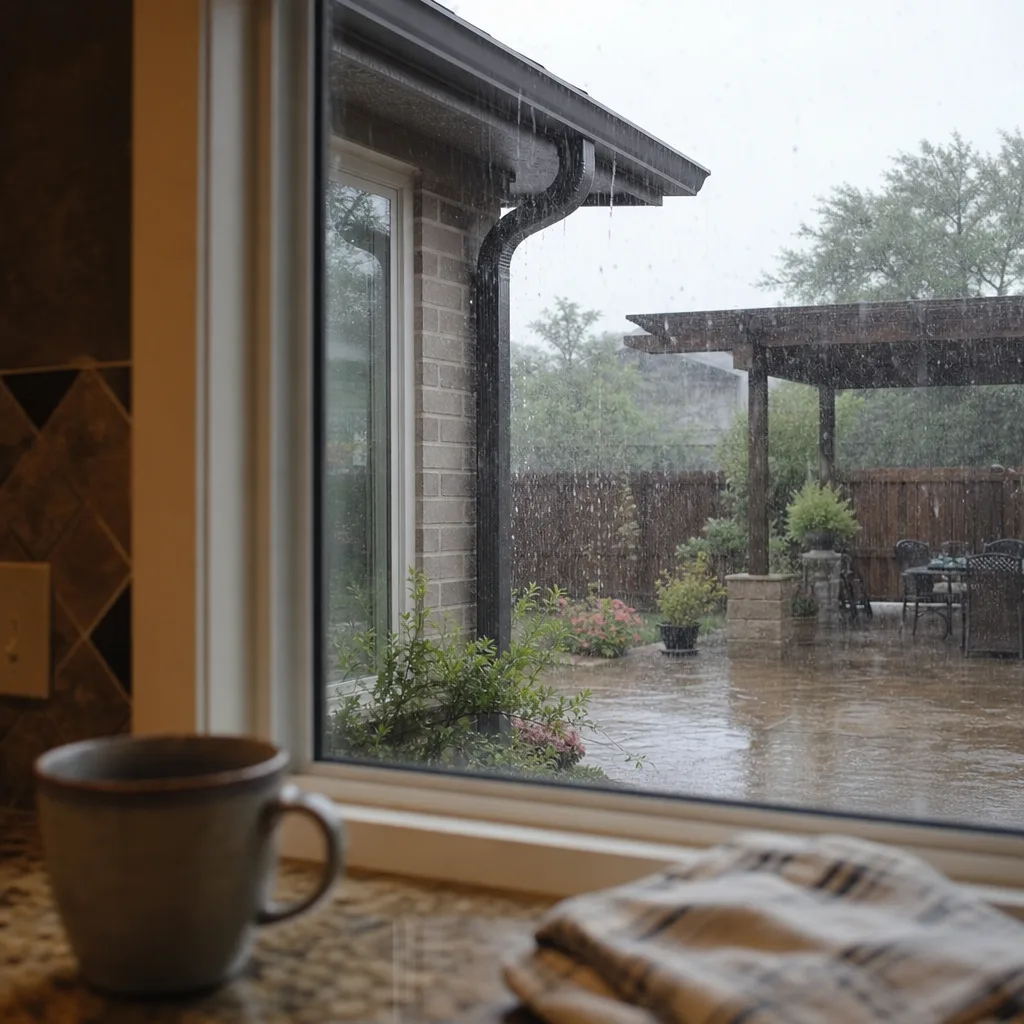
A few small steps the day before make things smoother:
- Move cars out of the driveway, or at least away from the house. The crew needs room for ladders and the long gutter runs.
- Clear a path along the walls. Move grills, patio chairs, potted plants, and anything hanging near the roof edge.
- Keep pets inside. There will be ladders, noise, and people walking along every side of the house.
- Give your neighbors a heads-up if your driveway or side yard sits close to theirs.
Work usually starts with the old gutters coming down. This is the moment of truth for your fascia, the board along the roof edge. Once the old gutter is off, the wood behind it is in plain view for the first time in years. If a section turns out to be soft or rotted, it needs to be fixed before new gutters go up, because a gutter is only as solid as the board it hangs on. You should hear about it right away, not after the job is done.
Then the seamless runs are formed. Each piece is shaped from a coil of metal and cut to the length of that wall, so you’ll see one long gutter carried up for each side instead of a pile of short sections. The installer sets the slope toward each downspout, fastens the hangers into the fascia, and seals the corners and end caps. Downspouts go on last, along with any extensions that carry water out past the clay around your slab.
Expect some noise and a lot of ladder traffic. A simple one-story home often wraps up in a day. A two-story home with several roof levels can take longer. At ERO DFW, a project manager coordinates the materials and the schedule, so you know who to ask when you have a question. Our crews protect your property while they work and keep the site clean.
Before anyone leaves, walk the house. ERO DFW finishes every job with a final walkthrough, and this is your chance to check the work with your own eyes. Look for these things:
- Water test. Ask for a hose to be run at the far end of a few runs. Water should flow to the downspout and drain out without dripping at the corners.
- Straight lines. From the street, each gutter should look even and sit tight to the fascia with no gaps or waves.
- Downspouts in the right spots. They should match the plan, and every one should empty away from your foundation.
- Clean ground. No old gutter pieces, metal scraps, or loose screws left in the beds or the grass. Those scraps are sharp and easy to miss with a mower.
If something doesn’t look right, say so during the walkthrough. It’s much easier to adjust a downspout or reseal a corner while the crew and ladders are still there.
Frequently Asked Questions
Common questions about seamless gutters in Sunnyvale, TX
How long do seamless gutters last?
Seamless aluminum gutters commonly last 25 years or more when they’re sized right and the hangers are solid. The lifespan drops fast if the fascia behind them rots or the seams at the corners fail early, so a proper install matters as much as the material.
Can one company handle both leak repair and full replacement?
Yes, most gutter contractors offer both, and the right call depends on what’s wrong. A good contractor will check for leaks, loose hangers, and misalignment first, since those are often repair jobs, not full replacements.
Do seamless gutters come in different colors to match my trim?
Yes, seamless aluminum gutters are available in a wide range of factory finishes, so you can match or complement your fascia and trim color. Ask to see color options before your install so the gutters blend in rather than stand out.
What’s the difference between seamless gutters and the sectional ones sold at hardware stores?
Seamless gutters are formed on-site from one continuous piece of metal for each wall, while sectional gutters are snapped together from short factory pieces. Fewer joints means fewer spots where sealant can crack and start a leak, which is the main reason seamless outlasts sectional in North Texas heat.
Ready to Get Started?
Schedule Your Free Inspection. Call (972) 288-9587 today.