
Copper Gutters vs. Aluminum: A Buying Guide for Sunnyvale, TX Homeowners
Copper gutters installed for homes where they fit – with a free inspection and a straight answer on whether copper is worth it for yours.
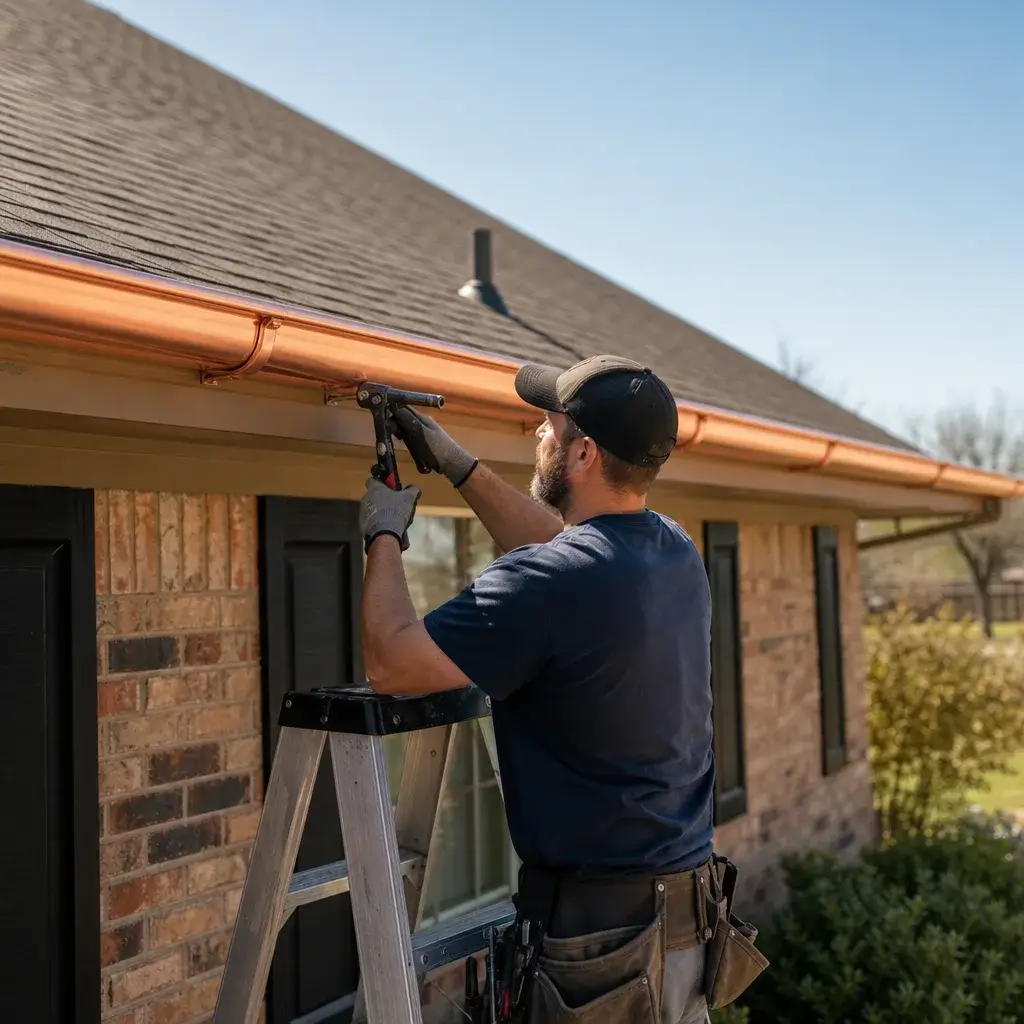
What’s Covered on This Page
- Copper Gutters vs. Standard Seamless Gutters
- Signs Your Home Is a Good Fit for Copper
- When Standard Gutters or Gutter Guards Make More Sense
- Getting the Gutter Size and Profile Right
- What Drives Copper Gutter Cost
- Will hail dent my copper gutters?
- Can I mix copper gutters with my existing aluminum downspouts?
- How long before copper gutters turn green?
- Do copper gutters need cleaning like regular gutters?
Copper Gutters vs. Standard Seamless Gutters
Both kinds of gutters do the same job. They catch the water off your roof and carry it away from your foundation. That matters a lot on North Texas clay, which swells when it’s wet and shrinks when it dries. The real differences are how long the gutters last, how they look as they age, and what you pay to get there.
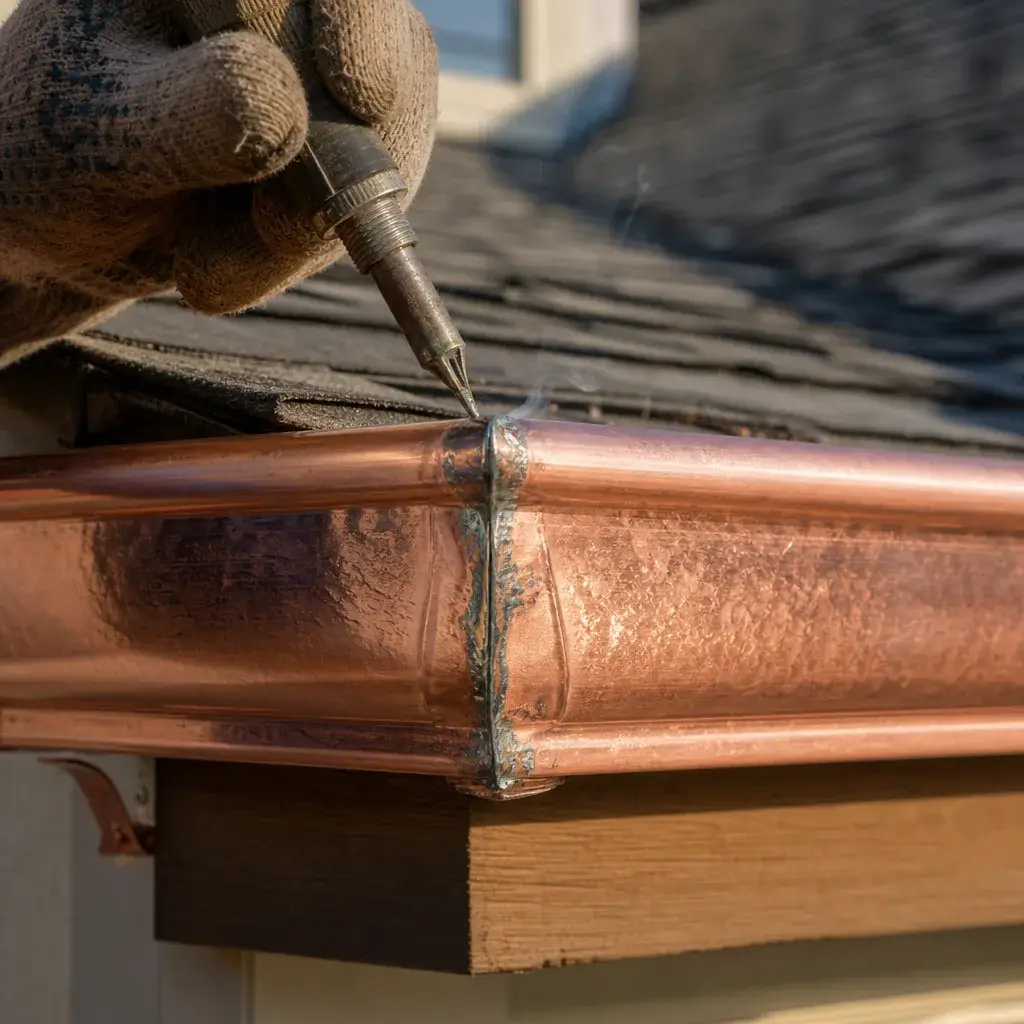
- Look: Aluminum is painted to match your trim and stays that color until the paint fades. Copper starts out bright, turns a deep brown within a few years, and slowly moves toward the blue-green patina you see on old buildings.
- Lifespan: Copper doesn’t rust, and there’s no paint to peel. Cared for, it can last for decades longer than aluminum.
- Seams: Seamless aluminum is formed on site in one long run, so the only joints are at the corners. Copper usually goes up in sections that are soldered together, and good soldering is a skill. That’s a big reason the labor costs more.
- Cost: Copper costs much more than aluminum, both the metal and the labor. Aluminum is the budget-friendly choice for most homes.
Hail is a fair question here. Copper is a soft metal, and a hard storm can dent it, just like it can dent aluminum. Thicker copper holds up better than thin copper, so ask what weight of copper a bid includes. A dent in copper doesn’t lead to rust, though. On copper, a dent is mostly a matter of looks.
Our summers matter too. A gutter that bakes on a hundred-degree afternoon and then cools after a thunderstorm grows and shrinks over and over. Long runs of either metal need room to move. Copper also has to be hung with copper or compatible hangers and fasteners. When copper touches aluminum or galvanized steel, the cheaper metal corrodes. That’s a common shortcut, and it ruins a good install.
There’s one more thing to know on a brick home in Sunnyvale. Water running off copper can leave green streaks on light stone, pale brick, or a white concrete patio. Against the red and brown brick common on slab-on-grade homes around here, copper usually looks right at home. Over light masonry, plan where the downspouts drain.
So which one fits you? Copper is a strong pick if you’re staying put for the long haul, your home has a traditional or custom look, or you want an accent over a front porch or bay window. You don’t have to wrap the whole house in copper to get the effect. If you want gutters that work well, match your trim, and keep money in your pocket for the roof or siding, seamless aluminum gutters are the honest answer. We install both, and we’ll tell you which one makes sense for your house.
Signs Your Home Is a Good Fit for Copper
A few things about your house tell you quickly whether copper deserves a closer look. Most of them have nothing to do with how much you like the color. They come down to timing, your roof, and the wood your gutters hang on.
- Your gutters are due anyway. If yours sag, pull away from the fascia, or spill over in a spring downpour, you’re buying new gutters either way. The only question left is which metal. Tearing out working aluminum just to put up copper is a much harder case to make.
- Your roof is new or about to be. Gutters hang right at the roof edge, and replacing a roof can disturb them. Hanging copper with a new roof, or soon after, means you won’t have to take it down again in a few years. If your roof is fifteen to twenty years old, get the roof checked first.
- Your roof is metal or tile, or it has dark architectural shingles. Copper looks natural next to these materials. Against a light gray shingle roof, it can look out of place.
- Your home already has copper details. A copper cap over a bay window, copper flashing at the chimney, or copper lanterns by the front door all give gutters something to match, so the whole front ties together.
- Your home suits a half-round profile. Half-round gutters have the rounded shape you see on older and traditional homes. Most North Texas homes use the flat-front K-style shape. Copper comes in both, and half-round copper on the right house is hard to beat.
- Your fascia is solid. Fascia is the board along the roof edge that the gutters fasten to. Copper is heavier than aluminum, so that board has to be sound. If it’s soft or rotted, it needs fascia and soffit repair before any new gutter goes up.
There are also times copper isn’t the right call, and you should hear that plainly.
- You plan to sell in the next few years. Copper pays you back through the decades it lasts, and you won’t be there for most of them.
- Your current gutters work fine. If they drain well, sit tight against the fascia, and send water away from the slab, there’s no rush. Wait until they need replacing.
- Your HOA requires gutters to match the trim. Some neighborhood rules call for gutters painted the same color as your trim, and bright new metal may need approval. Check your rules first. Once you approve the work, our project manager handles HOA approvals with you.
A storm claim brings up one more question. Say a spring hailstorm dented your aluminum gutters and your insurer is covering them along with the roof. Policies generally pay to replace damaged gutters with similar ones. If you’d like copper instead, plan on paying the difference yourself. That can still be a smart time to upgrade, since the gutters are coming down anyway.
If you’re not sure where your house lands, that’s what the free inspection is for. We’ll check the fascia, the roof edge, and where your water ends up. Then you’ll get an honest opinion and a written estimate for copper, aluminum, or both, so you can compare them side by side.
When Standard Gutters or Gutter Guards Make More Sense
Copper is a material choice. It doesn’t fix a drainage problem. Before you pick a metal, ask what’s bugging you about the gutters you have now. Often the honest answer is something smaller and cheaper.

Your gutters keep clogging. Copper clogs just like aluminum does. Leaves, seed pods, twigs, and shingle granules pile up the same way in both. When a spring storm or straight-line wind strips your trees, that mess lands right in the gutter. Then the next downpour spills over the edge. If clogging is your problem, gutter guards are the fix. These are covers or screens that sit over the gutter, so water gets in and most of the debris stays out. They fit on new or existing gutters, and there are versions made for copper if you go that way later.
Guards also make sense on a tall house. Many newer two-story homes in North Texas have gutters well over 20 feet up. Cleaning them means a long ladder and a real risk of a fall. Guards cut down on those trips. To be straight with you, they don’t make gutters maintenance-free. Fine debris can still collect on top, so plan to check them now and then.
Water is pooling at your slab. Look at your downspouts before you look at your gutters. Common culprits are easy to spot from the yard:
- Too few downspouts for a long stretch of roof, so water backs up and overflows in a heavy rain.
- Downspouts that are too narrow to keep up with a Texas thunderstorm.
- Downspouts that dump water right next to the foundation instead of carrying it out into the yard.
Adding a downspout, upsizing one, or extending where it drains costs far less than new gutters. On our clay soil, that one change can do more for your foundation than any metal upgrade.
Only one part is failing. A leaking corner, a few loose hangers, or one sagging run after a storm is usually a gutter repair, not a full replacement. If the rest of the system is sound, fix what’s broken and keep your money.
Your budget has a bigger job to do. If your roof is near the end of its life, or your siding or fascia needs work, put your money there first. New seamless aluminum gutters drain your roof just as well as copper. They let you spend where it protects the house most. You can always add a copper accent over the front porch down the road.
None of this means copper is a bad choice. It just means copper is the right answer when you want it for the long life and the look. It’s the wrong answer when you’re really trying to stop a clog or a puddle by the slab.
Need help with your copper gutter project?
Schedule Your Free Inspection. Exteriors, Roofing & Outdoor Living is ready to help.
Getting the Gutter Size and Profile Right
Copper only earns its price if it carries the water. A beautiful gutter that spills over in a spring storm is still a failed gutter. Size and shape matter as much as the metal, and they’re worth settling before anyone talks color or patina.
Width depends on how much water your roof sends down. Three things drive that. The first is how big each section of roof is. The second is how steep it is. The third is how hard it rains. North Texas thunderstorms can dump a lot of water in a short burst, and a gutter has to keep up with the worst ten minutes of the storm, not the average. Most homes do fine with a 5-inch gutter. A large two-story roof, a steep pitch, or a long run with few downspouts often calls for a 6-inch gutter.
Watch the spots where two roof slopes meet in a valley. A valley funnels water from both sides into one small stretch of gutter. In a heavy rain it can shoot right over the front edge. That stretch may need a wider gutter, a splash guard, or a downspout placed close by.
Shape changes the math. A half-round gutter holds less water than a K-style gutter of the same width, because the rounded bottom has less room inside. So if you love the half-round look, plan on going up a size. A 6-inch half-round is a common choice where a 5-inch K-style would have been enough. Skip that step and you can end up with a lovely gutter that can’t handle a hard Texas rain.
The downspouts need to match the gutter in both size and style. Round copper downspouts go with half-round gutters. Rectangular ones go with K-style. A wide gutter feeding a narrow downspout just moves the overflow to a new spot. The look matters here too. Downspouts run right down the face of your house, so on a brick home in Sunnyvale they’re a big part of how the copper reads from the street.
Hangers and pitch finish the job. Half-round copper usually hangs on brackets you can see from below, so they should be evenly spaced and made of copper. K-style can use hangers hidden inside the gutter. Either way, the gutter needs a slight, steady slope toward each downspout. Water that sits in a flat spot leaves debris behind and adds weight. If the slope is too steep, the gutter looks crooked along the roofline.
Your written estimate should spell all of this out. Before you compare prices, check that each bid lists:
- The gutter width and profile for each side of the house, not one size for everything
- The number, size, and shape of the downspouts
- The copper weight, hanger type, and hanger spacing
- How the valleys and long runs will be handled
If two copper bids look far apart on price, the answer is often in these lines. One may be quoting thinner metal, fewer downspouts, or a gutter one size too small for your roof.
Watch Our Video
See How We Handle Copper Gutters in Sunnyvale, TX
Exteriors, Roofing & Outdoor Living — Serving Sunnyvale, TX and surrounding areas
What Drives Copper Gutter Cost
No honest contractor can give you a copper gutter price over the phone. The total depends on your house, the choices you make, and what copper is selling for that month. Once you know what moves the number, a quote stops feeling like a mystery, and you can decide where to spend and where to save.

Most gutter bids start with a per-foot price for the gutter. Then they add the parts that don’t come by the foot. Some contractors roll everything into one job price instead. Either way is fine, as long as the written estimate shows what’s included. Here’s what drives the total:
- How many feet you’re covering. A single copper run over the front porch costs a small slice of what a whole house costs. This is the biggest lever you control.
- The price of copper itself. Copper is traded like other raw metals, and its price rises and falls. A quote from last spring may not hold this fall, so ask how long yours is good for.
- Corners and joints. Every inside and outside corner has to be cut, fitted, and soldered by hand. A plain rectangle of a ranch home has few corners. A two-story home with bump-outs, gables, and porches can have many more.
- Profile. Half-round copper often costs more than K-style. As noted above, it may need to go up a size to carry the same water.
- Downspouts. Each one adds copper, an elbow or two, and labor. Tall walls mean longer downspouts.
- Height and access. Working at the second-story roof edge takes more time, more ladder work, and more care than a single-story eave. Steep roofs and tight side yards add time too.
- Removing the old gutters. Ask whether taking down and hauling off your current gutters is included or billed on its own.
- Repairs found along the way. If the fascia behind your old gutters is soft, that board gets fixed before copper goes up, and it shows up on the bill.
- Extras. Decorative hangers, leader heads (the box at the top of a downspout), rain chains, pre-aged copper that already looks weathered, and guards made for copper all add cost. None of them is required.
Some choices drop the price without hurting the job. You can put copper only where people look, like the front of the house or the porch, and run seamless aluminum around the back. You can stick with K-style if your home doesn’t call for half-round. You can also skip the decorative add-ons for now and add them later.
There’s one place not to save. If a copper bid comes in well below the others, check the details before you get excited. Thin copper, the wrong fasteners, or fewer downspouts can all make a low number look good on paper. Those shortcuts cost you later.
Before you hire anyone, ask these questions:
- Is this a per-foot price or one total, and what’s left out?
- How long is this price good for, given copper prices?
- Does it include tearing out and hauling off my old gutters?
- What happens to the price if you find rotted fascia?
- Who does the soldering, and have they soldered copper gutters before?
Copper is a long-term purchase, and you don’t have to pay for it all at once. ERO DFW offers financing, and you’ll always get a written estimate before you sign anything. That way you can see exactly what you’re paying for, line by line, and compare it fairly.
Frequently Asked Questions
Common questions about copper gutters in Sunnyvale, TX
Will hail dent my copper gutters?
Yes, a hard North Texas hailstorm can dent copper, since it’s a soft metal, just like it can dent aluminum. Thicker copper holds up better than thin copper, so ask your contractor what weight of copper is in your bid. The good news is a dent in copper doesn’t lead to rust or a leak. It’s mostly a cosmetic issue, not a performance one.
Can I mix copper gutters with my existing aluminum downspouts?
No, you shouldn’t mix copper with aluminum or galvanized steel hangers and fasteners. When copper touches those cheaper metals, the cheaper metal corrodes quickly. This is a common shortcut on lower bids, and it can ruin an otherwise good install. Make sure every hanger, screw, and downspout piece touching your copper gutters is copper or a compatible metal.
How long before copper gutters turn green?
Copper starts out bright and shiny, then turns a deep brown within the first few years. From there it slowly moves toward the blue-green patina seen on old buildings, though the full color change takes longer than that first few years. On a brick home in Sunnyvale, that aging color usually looks right at home against red and brown brick.
Do copper gutters need cleaning like regular gutters?
Yes, copper clogs just as easily as aluminum does. Leaves, seed pods, twigs, and shingle granules build up the same way in both metals. If spring storms or straight-line winds strip debris into your gutters often, gutter guards can cut down on how frequently you need to clean them out.
Ready to Get Started?
Schedule Your Free Inspection. Call (972) 288-9587 today.