
Flashing Repair in Sunnyvale, TX
Failed flashing around chimneys, vents and walls repaired properly, not patched with caulk – starting with a free inspection that finds the real cause.
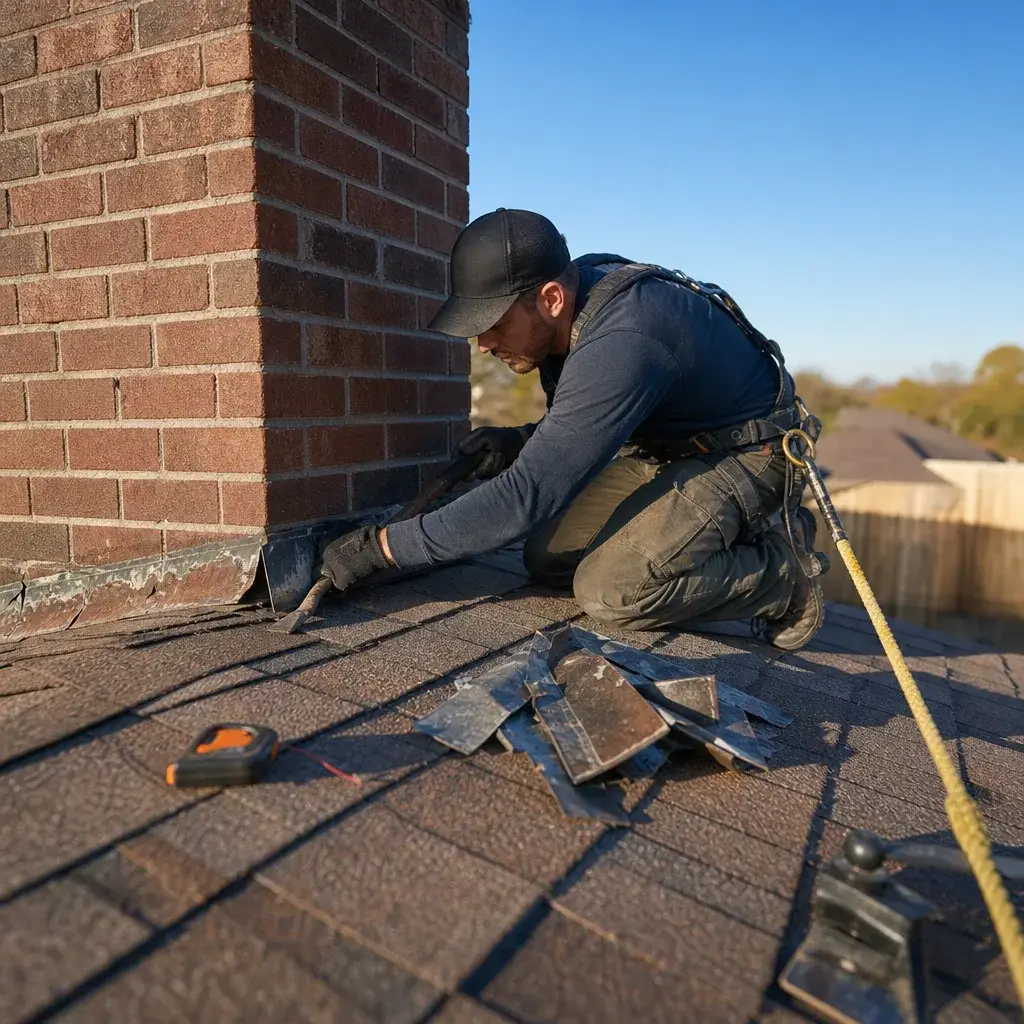
What’s Covered on This Page
- A Ceiling Stain or Leak Near a Chimney Usually Means Flashing Has Failed
- Know When Flashing Damage Needs a Call Now, Not Later
- A Free Inspection Finds the Real Cause Before Any Work Begins
- Why a Caulk or Sealant Patch Is Not a Lasting Fix
- Storm-Driven Flashing Damage May Be Covered by Your Insurance Claim
- How long does a typical flashing repair take to finish?
- Can flashing repair be done in the rain or right before a storm?
- Will fixing flashing mean replacing some of my shingles too?
A Ceiling Stain or Leak Near a Chimney Usually Means Flashing Has Failed
Flashing is the thin metal that bends around the edges of your chimney, runs along the wall where a lower roof meets a second story, and wraps vent pipes and skylights. It covers seams that shingles can’t seal on their own. If you’re looking at a brown ring on the ceiling near the fireplace, or a damp spot on an upstairs wall next to a roofline, flashing repair is one of the first things to rule in or out.
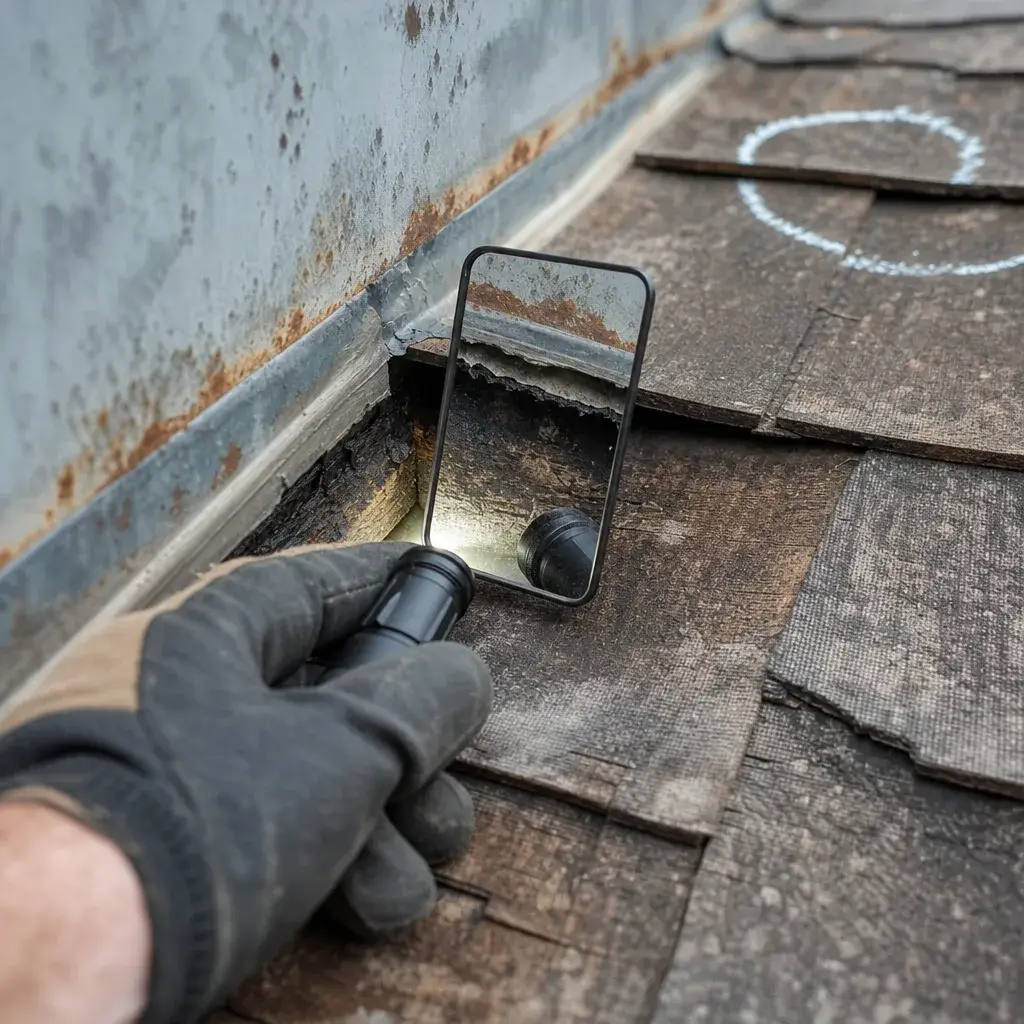
Here’s what failed flashing tends to look like, inside and out:
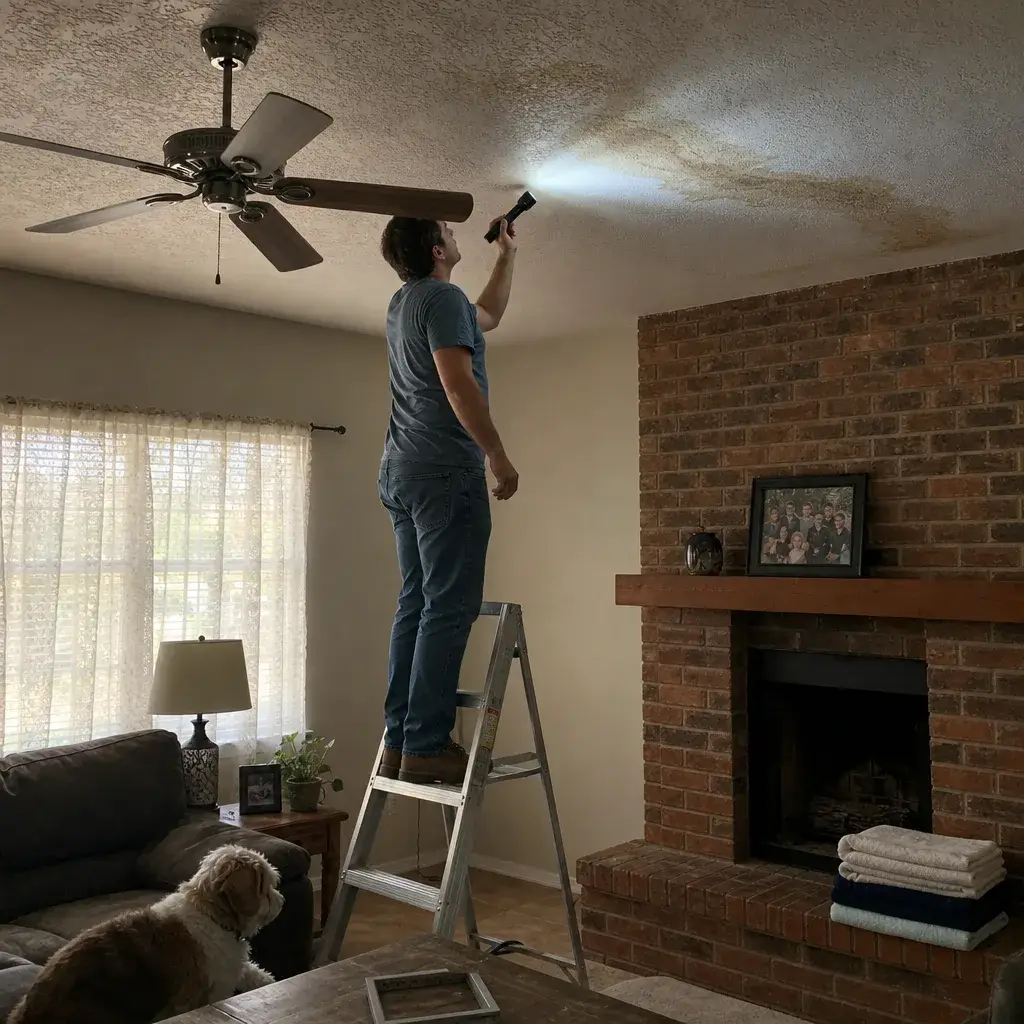
- A stain or drip on the ceiling close to the chimney, a vent pipe, or a skylight
- Water on an interior wall right below where a roof slope meets a second-story wall
- A leak that only shows up in hard, sideways rain, not in a gentle shower
- Metal around the chimney that’s pulled away from the brick or has gaps where it meets the top
- Cracked, dried-out caulk or sealant along the flashing
- Rust streaks, dents, or bent metal at roof joints after a storm
- Peeling paint or soft drywall near the fireplace
North Texas is hard on these joints. Summer heat and strong UV bake the sealant that holds flashing tight, so it shrinks and cracks over a few seasons. Spring hail can dent or bend the metal, and straight-line winds push rain sideways, right into a seam that would stay dry in a straight-down rain. In the occasional ice storm, water that freezes and thaws in a small gap can open it wider.
The type of home matters too. Many brick homes in and around Sunnyvale have brick chimneys, where the flashing is set into the mortar joints near the top. When that mortar wears or the metal works loose, water runs behind it. Larger two-story homes have long stretches where a lower roof butts into a wall. Each of those joints is a spot where flashing has to do its job.
One thing that throws people off: the stain isn’t always right under the problem. Water can land on the roof deck, which is the wood layer under your shingles, then run along a rafter for a few feet before it drips onto your ceiling. A stain a little ways from the chimney can still trace back to the chimney flashing. That’s why the source should be checked from the roof and the attic, not guessed from inside the room.
This is the good news. If the leak lines up with a joint and the rest of your roof is in decent shape, you may be looking at a focused repair on one spot. A stain on your ceiling isn’t proof you need a whole new roof. It’s a reason to find out exactly where the water is getting in.
Know When Flashing Damage Needs a Call Now, Not Later
Here’s the simple test. If water is coming in right now, or more rain is on the way, call today. If you found an old stain that hasn’t changed, you can book a free inspection for later this week. What matters is whether the leak is active and whether the weather is about to test that joint again.
Call right away if you notice any of these:
- Water dripping from the ceiling or running down a wall during or right after a rain
- A stain near the chimney, a skylight, or a roof-to-wall joint that’s bigger or darker than it was a few days ago
- Drywall that feels soft, bulges, or has started to sag
- Flashing you can see from the yard that’s hanging loose, flapping in the wind, or bent back after a storm
- A hailstorm just came through, the metal at your roof joints looks dented, and the forecast calls for more rain
Waiting costs more than it seems to. A small gap at the chimney doesn’t stay small inside your home. Every rain soaks a little more of the roof deck, the insulation in your attic, and the drywall below. Fixing one piece of metal is a focused job. Fixing wet insulation, stained ceilings, and soft decking on top of that is a bigger one. Catch it early and you’re paying for the flashing, not everything the water touched.
Timing matters more here in North Texas. Spring hail season runs roughly March through June, and storms can roll through just days apart. A joint that a storm bent on Tuesday can take on water in Friday’s storm. If a permanent repair can’t happen before the next round of rain, a temporary cover may be the right first step. ERO DFW also handles emergency roof repair and tarping, which has its own page.
Now the honest part. Not every flashing problem is an emergency. Maybe the stain is old, dry, and the same size it’s been for months. Maybe you spotted cracked caulk around a vent pipe from the driveway, but nothing’s showing up inside. In those cases, you don’t need to drop everything or pay for a rush. Book an inspection for a dry day this week. Just don’t let it ride into the next storm season, because sun-baked sealant only keeps cracking.
Either way, grab your phone and take a few dated photos of the stain and any damage you can see from the ground. You don’t need to climb up on the roof. Those photos help whoever inspects it. If a storm caused the damage, they’re also useful for an insurance claim. If it comes to that, we’ll walk you through the claim one step at a time.
A Free Inspection Finds the Real Cause Before Any Work Begins
A stain near your chimney points to the flashing, but it doesn’t prove it. Before anyone pulls up a shingle, you want to know three things. Is the flashing really the leak? Can it be fixed in place, or does it need new metal? Did the water damage anything under it? A good inspection answers all three from the roof and the attic. It shouldn’t be a guess made from your living room.
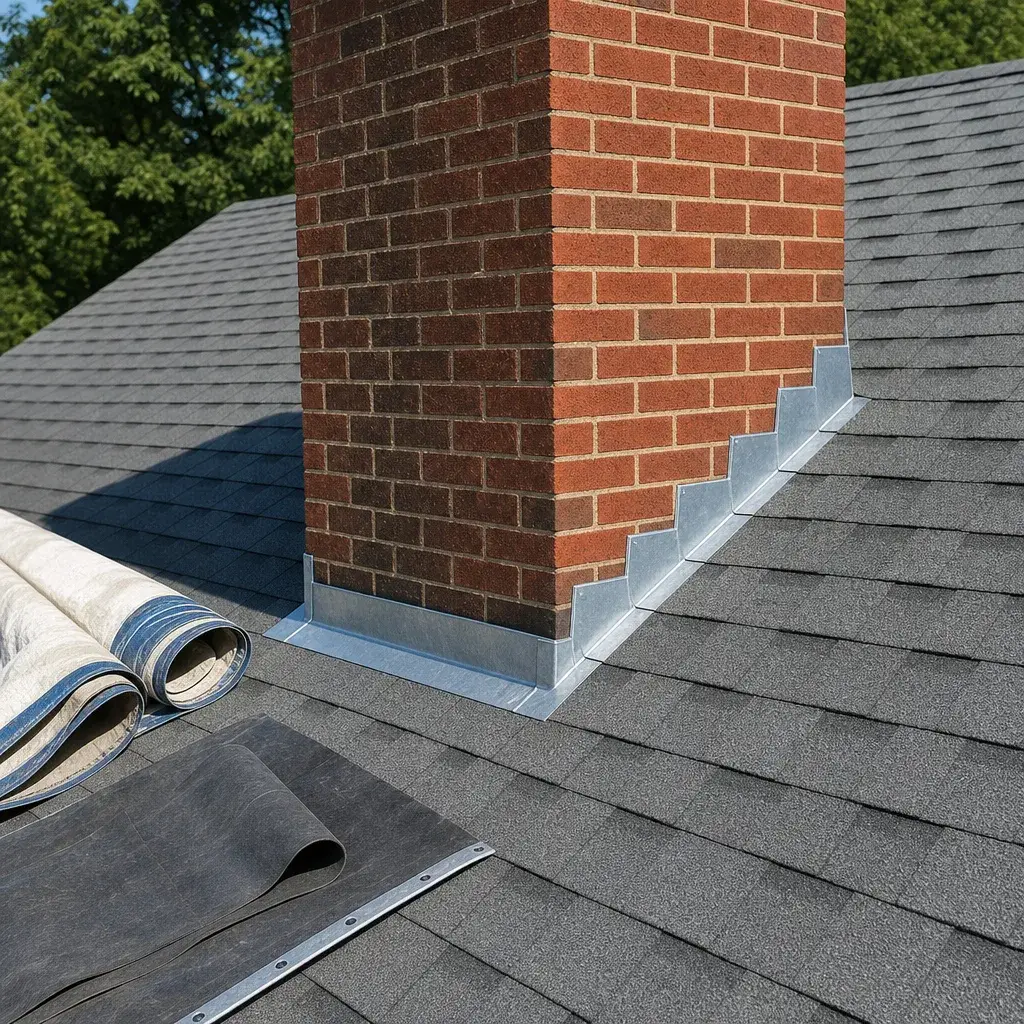
Some leaks look exactly like a flashing failure. Before paying for flashing work, it helps to rule these out:
- A cracked chimney cap or worn brick that soaks up rain above the flashing
- A split rubber boot around a vent pipe, which is a different part from the metal flashing
- A skylight seal or cracked lens, not the metal around the skylight
- Gutters that back up in a heavy storm and push water under the roof edge
- Damaged or missing shingles a few feet uphill from the joint
If it isn’t the flashing, you should hear that plainly. Paying to reflash a chimney won’t stop water that’s coming through the brick. That’s what we mean by free inspection, honest opinion.
When flashing is the problem, the fix can be small or fairly involved. These are the things that move the cost up or down:
- Resealing versus replacing. Fresh sealant on sound metal is a small job. Bent or rusted metal needs new flashing.
- Where the joint is. A vent pipe is quick. A chimney or a long roof-to-wall line takes more time and material.
- Shingles in the way. Step flashing, the small bent pieces woven between shingles along a wall or chimney, often means lifting or replacing nearby shingles.
- Mortar work. On brick chimneys, the metal may need to be reset into fresh cuts in the mortar near the top.
- Roof type and height. Tile, metal, steep slopes, and second-story roofs take more care and safety setup.
- Hidden damage. Soft decking or wet insulation under the joint adds repair work.
Whoever you call, ask a few questions before you agree to anything. Will you replace the metal or just add caulk over it? How will you match or replace the shingles you remove? What exactly is included, written down? A caulk-only patch on bent flashing can buy a season. In North Texas sun, it rarely buys much more.
With ERO DFW, a sales manager looks at your roof, explains your options, and gives you a written estimate before you sign anything. If hail or wind caused the damage, our project manager can meet your insurance adjuster on site, and we’ll walk you through the claim. You pay your deductible, nobody else. We’re licensed, bonded, and insured, family-owned since 2019, and headquartered in Sunnyvale. That makes us easy to find if you ever have a question about the work.
Have questions? We’re happy to help.
Schedule Your Free Inspection. Exteriors, Roofing & Outdoor Living is ready to help.
Why a Caulk or Sealant Patch Is Not a Lasting Fix
A tube of caulk is cheap, quick, and easy to sell. That’s why it shows up on so many roofs. But flashing was never meant to depend on goo. Good flashing keeps water out by overlap and gravity. Each piece of metal laps over the one below it, the same way shingles do, so rain runs down and off. When that metal is bent, rusted, or missing, caulk on top only covers up the problem.
Here’s why a caulk-only patch tends to let go:
- The metal moves. Flashing grows a little in the afternoon heat and shrinks at night. Caulk can’t stretch that much, day after day, so it pulls loose at the edges.
- It doesn’t stick well to a bad surface. Rust, old sealant, dust, and wet brick all keep new caulk from bonding. It can look sealed and still have a gap behind it.
- It can trap water. Caulk smeared across the bottom of a joint can block the path water needs to drain out. Instead of running off, the water sits and finds the next weak spot.
- It hides the real damage. A thick bead of sealant over a chimney or wall joint makes it harder for anyone to see what’s under it the next time there’s a leak.
Picture a brick chimney where the metal has worked loose from the mortar near the top. Someone runs caulk along that gap. It looks fine from the yard. A few months later, the caulk has pulled away from the brick, and water is running behind the flashing again. Now there’s also a crust of old sealant that has to be scraped off before the joint can be fixed the right way.
A lasting repair goes after the metal itself. That can mean new step flashing woven in with the shingles along a wall or chimney. It can mean counterflashing, the second layer of metal that covers the top of the step flashing, set back into fresh cuts in the mortar. On two-story homes, it often means checking for kickout flashing. That’s a small bent piece at the bottom of a roof-to-wall joint that turns water into the gutter instead of letting it run down behind your siding or brick. When it’s missing, rot and stains near the bottom of that wall are common.
To be fair, sealant does have a place. A proper repair still uses it in small spots, like the edge of counterflashing or over exposed nail heads, as a backup to the metal. And if a storm is coming and the right repair can’t happen first, a careful patch can help keep water out for a few days. That’s fine, as long as everyone calls it what it is: a stopgap.
So if a quote for your leak is just “seal the chimney,” ask what’s happening to the metal underneath. A focused flashing repair is still a small job next to a new roof. It just has to fix the part that’s failing.
Watch Our Video
See How We Handle Flashing Repair in Sunnyvale, TX
Exteriors, Roofing & Outdoor Living — Serving Sunnyvale, TX and surrounding areas
Storm-Driven Flashing Damage May Be Covered by Your Insurance Claim
If a hailstorm dented the metal at your chimney or high wind peeled back the flashing along a wall, that damage may be part of a homeowners insurance claim. Most policies are written to cover sudden damage from a storm. They usually aren’t written to cover parts that simply wore out. So the big question isn’t just whether the flashing failed. It’s what made it fail.
Here’s how that line usually gets drawn. Every policy is different, so your own policy has the final word.
- More likely to be storm damage: fresh dents or creases in the metal, flashing bent back or torn loose after high wind, and hail marks on nearby shingles, vents, or gutters from the same storm.
- More likely to be wear and tear: sealant that’s cracked from years of sun, rust that built up slowly, and mortar that crumbled over time around a chimney.
- Often a mix: an older joint that a storm finally pushed past its limit. That’s where a careful inspection and good photos matter most.
Be ready for one honest possibility. A flashing repair on one chimney or one vent can cost less than your deductible. If it does, a claim may not make sense, and you’d likely just pay for the repair yourself. On the other hand, if the same storm also bruised your shingles or dented your gutters, the flashing can be one line in a bigger roof claim. You’ll want to know which situation you’re in before you call your insurer.
If it does look like a claim, this is the usual order of things:
- Get the damage inspected and documented, so you know what the storm did before you file.
- File the claim with your insurance company, and note the date of the storm.
- Your insurer sends an adjuster. That’s the person who looks at the roof and decides what the policy covers.
- Our project manager can be there for that visit, so the adjuster sees the same joints and dents we found.
- Your insurer sends a written decision. You read it, ask questions, and decide what happens next.
- Once the work is approved, the repair is scheduled. You pay your deductible.
About that deductible. Texas law says the homeowner pays it. A contractor isn’t allowed to waive it, cover it, or hide it inside a padded bill. If someone at your door after a storm offers to take care of your deductible, that’s a red flag, not a favor. The Texas Department of Insurance is the state agency that oversees insurers, and it’s a good place to check your rights if anything about a claim feels off.
We can’t promise what your insurer will approve, and nobody honest can. What we can do is show you what we found, explain it in plain English, and stand next to you while the adjuster looks.
Frequently Asked Questions
Common questions about flashing repair in Sunnyvale, TX
How long does a typical flashing repair take to finish?
Most single-joint flashing repairs, like at a vent pipe or one section of chimney, take just part of a day. A chimney with step flashing woven into nearby shingles, or a long roof-to-wall line, takes longer because shingles may need to come up and go back down. We’ll give you a time estimate during your free inspection once we see exactly which joints need work.
Can flashing repair be done in the rain or right before a storm?
No, flashing repair needs dry conditions so the metal, mortar, and any sealant can be set properly. If rain is close and the permanent fix can’t happen first, a temporary cover can keep water out until the weather clears. Spring hail season in North Texas, roughly March through June, often means storms just days apart, so timing a dry repair window matters.
Will fixing flashing mean replacing some of my shingles too?
Sometimes, yes. Step flashing is woven between shingles along a wall or chimney, so reaching it often means lifting or replacing the shingles right next to that joint. We’ll walk you through exactly which shingles need to come up before any work starts, so there are no surprises on the invoice.
Ready to Get Started?
Schedule Your Free Inspection. Call (972) 288-9587 today.