
Roof Repair or Replacement? How to Tell in Sunnyvale, TX
Leaks, lifted shingles and flashing failures fixed right – plus a free inspection that tells you honestly whether a repair is enough.
What’s Covered on This Page
- Signs Your Roof Needs Repair, Not a Full Replacement
- When Roof Repair Is the Right Call and When It Isn’t
- What Happens During a Roof Repair Inspection and Estimate
- Storm and Hail Damage Repair and the Insurance Claim Process
- What Drives Roof Repair Cost Up or Down
- How long does a typical roof repair take?
- Can I do a temporary roof patch myself before calling a roofer?
- Will a small roof repair affect my home’s resale value or inspection?
- What should I do if I notice a roof problem but I’m not sure it’s urgent?
Signs Your Roof Needs Repair, Not a Full Replacement
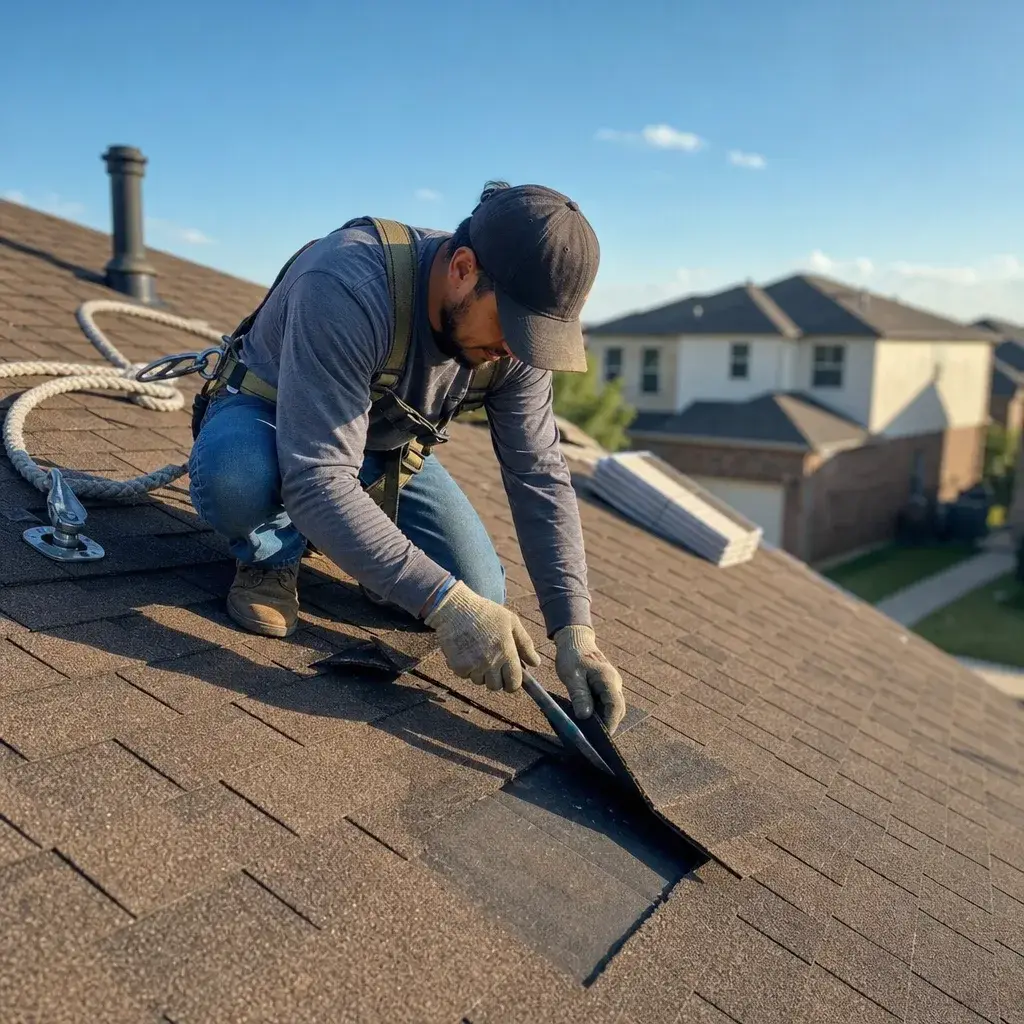
Something going wrong with your roof doesn’t mean the whole roof has to come off. A lot of what North Texas weather does to a roof is local damage. A gust tears off a few shingles. A seal around a pipe dries out. One corner takes the worst of a storm. When the trouble stays in one spot, you’re usually looking at a repair.
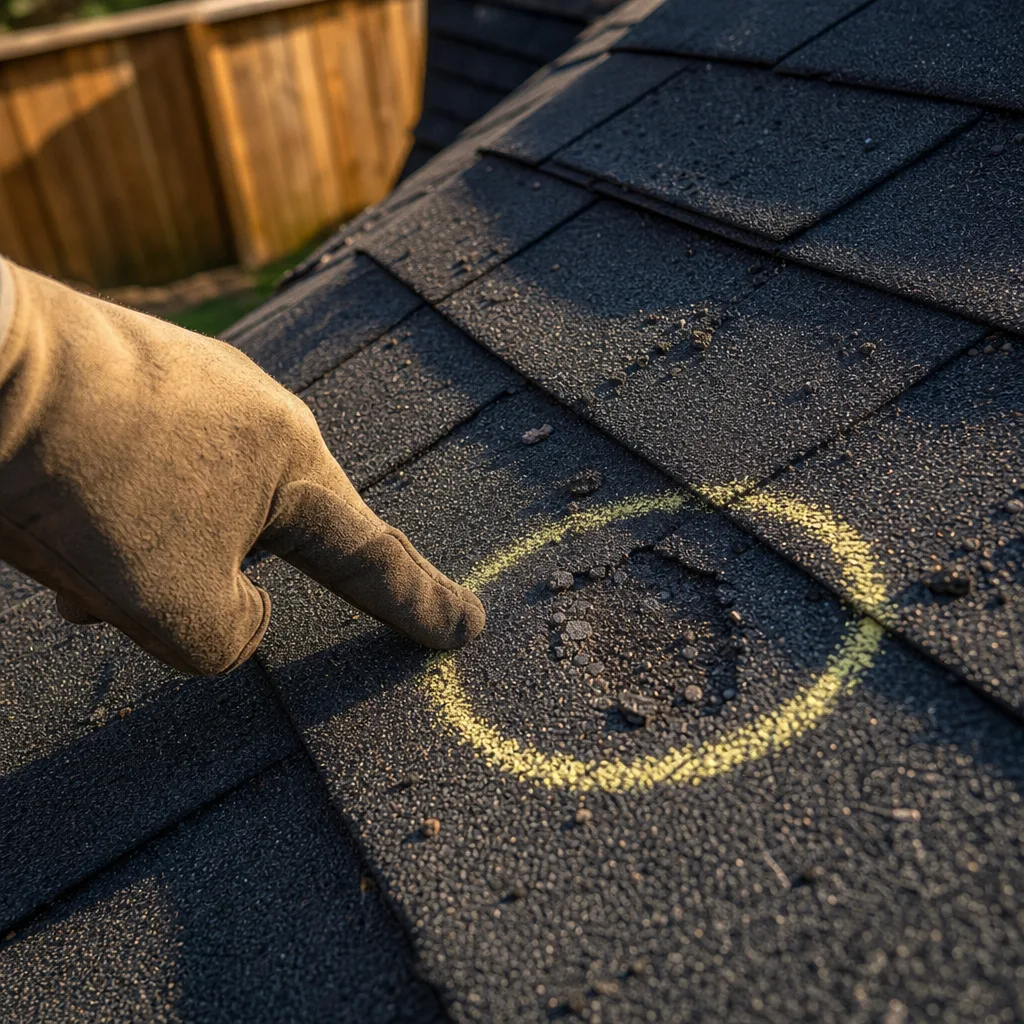
These signs usually point to a repair:
- A few missing or creased shingles after a straight-line wind, while the rest still lie flat and sealed.
- A leak you can trace to one spot, often bad flashing. Flashing is the thin metal that seals the joints where your roof meets a chimney, a wall, or a vent.
- A cracked rubber boot around a vent pipe. Hundred-degree summers and strong sun dry these out long before the shingles wear out.
- Hail dents on vents or gutters, or hits on one slope, while the other slopes still look solid.
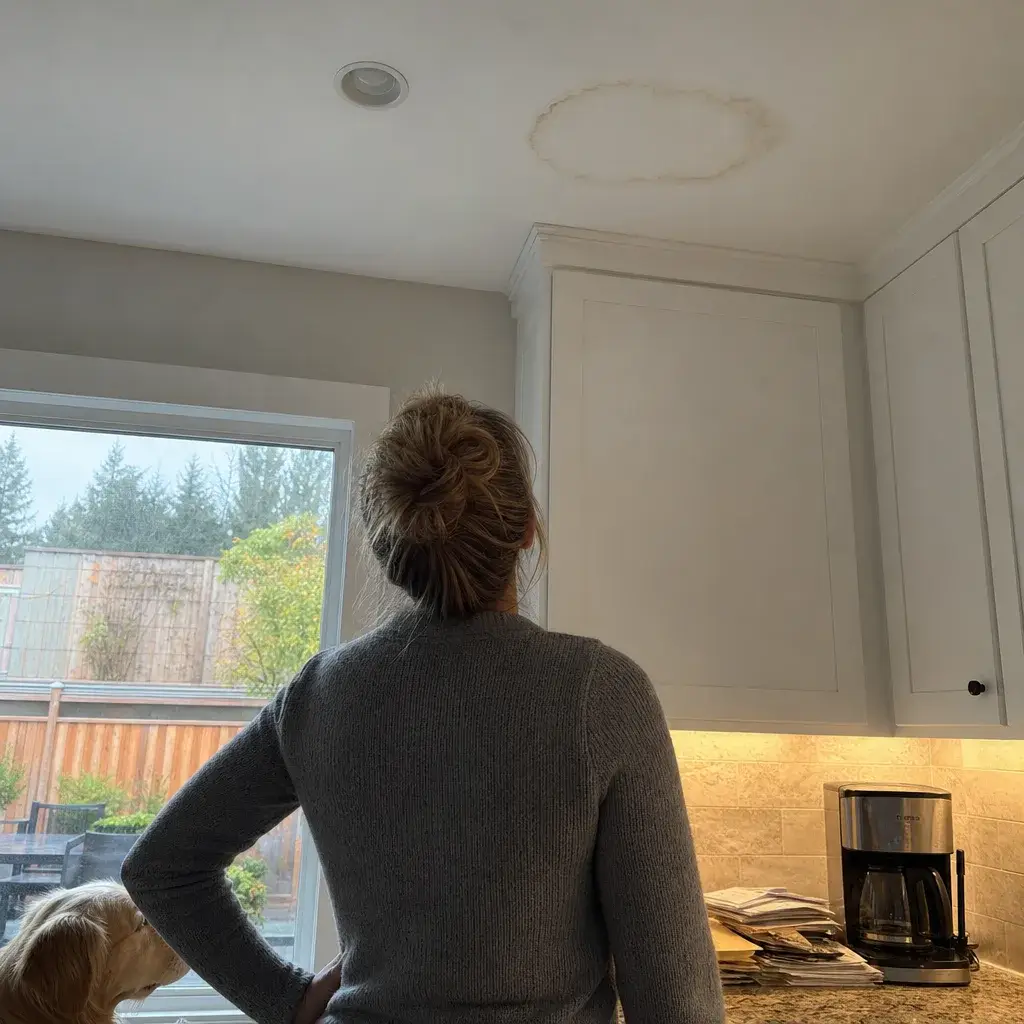
- A stain on the ceiling that showed up after one storm and hasn’t spread.
- Rotted fascia, the trim board behind your gutters, at one corner where water has been spilling over.
These signs mean patching is just buying time:
- Damage on several slopes at once, the kind a big spring hailstorm can leave between March and June.
- Shingles curling, cracking, or going bald across the roof, with granules piling up in your gutters.
- Soft or spongy spots that give when someone walks on them. That means the decking, the wood boards under the shingles, may be rotting.
- New leaks in different places, year after year.
- A roof that’s fifteen to twenty years old where the repairs keep stacking up.
Where you live in Sunnyvale changes what you can see for yourself. On a one-story brick ranch, you can stand in the yard and get a decent look at most of the roof. On a larger two-story home in a newer subdivision, the back slopes and the high valleys are mostly hidden from the ground, and that’s often where damage sits. Please don’t climb up to check. A pair of binoculars from the driveway is plenty for a first look.
On an older roof, shingle color matters too. Shingles fade in the Texas sun, so new ones might not match the old ones exactly. A patch can keep you dry and still look different from the rest of the roof. That’s worth knowing before you decide, especially if you plan to sell soon.
You shouldn’t have to guess, and you shouldn’t take the word of someone who knocked on your door an hour ago. When our team looks at your roof and a repair is the right fix, we’ll tell you so and put it in writing before you sign anything. If the roof really is done, you’ll hear why, and you’ll see the damage for yourself.
When Roof Repair Is the Right Call and When It Isn’t
A repair is the right call when there’s one clear failure you can point to, like a cracked vent boot, a lifted piece of flashing, or a handful of missing shingles. The rest of the roof also needs plenty of life left. If that’s your roof, fix it and move on. But not every stain, drip, or loose granule means you need a roofer. Here are the times we’d tell you to hold off or look somewhere else first.
The stain might not be coming from the roof. In a lot of North Texas homes built on a slab, the AC unit sits up in the attic. In a Sunnyvale summer, that unit sweats hard. A clogged drain line or an overflowing drip pan can leave a ceiling stain that looks exactly like a roof leak. Bathroom vent fans that dump moist air into the attic can do the same thing. Ask yourself one question: does the stain grow after rain, or does it show up on dry, hot days? If it’s the dry days, have the AC or the fan looked at before you pay anyone to touch your shingles.
Some things look like damage but are normal:
- A sprinkle of granules in the gutters during the first few months after a new roof. New shingles shed some extra granules as they settle. Steady heavy loss on an older roof is a different story.
- Gutters spilling over in a hard rain because they’re packed with leaves. A good clean-out may be all you need.
- Dark streaks on the shingles. That’s usually algae, and it’s a looks problem, not a leak problem.
Sometimes waiting is the smart move. If you already know your roof is due for replacement in the next few months, don’t spend money patching a small cosmetic problem that isn’t letting water in. Put that money toward the new roof.
After a big storm, a quick repair may not be your first step. If hail or wind hit several slopes, the damage may be part of an insurance claim. Before anything gets patched, take photos of what you see from the ground and inside the house. Write down the storm date. Keep receipts for anything you do to stop water from getting in. Paying out of pocket to fix storm damage before it’s documented can make the claim harder to sort out later.
If water is coming in right now, a full repair isn’t the first job. A tarp is. Wet shingles and slick decking aren’t safe to work on, and a proper repair needs a dry roof. Cover the roof first, protect what’s inside, and do the real fix once the weather clears. That’s what emergency roof repair and tarping is for.
And if your home inspector flagged the roof during a sale, read the note closely. “Near end of life” and “active leak at the chimney” are very different findings. One may only need a simple repair, and the other may be something to negotiate with the seller.
What Happens During a Roof Repair Inspection and Estimate
It starts with a phone call. We respond to every inspection request within 24 hours, and the inspection is free. One of our sales managers comes out to your home, looks over the roof, explains your options in plain English, and gives you a written estimate before you decide. You don’t owe anyone a decision on the spot.
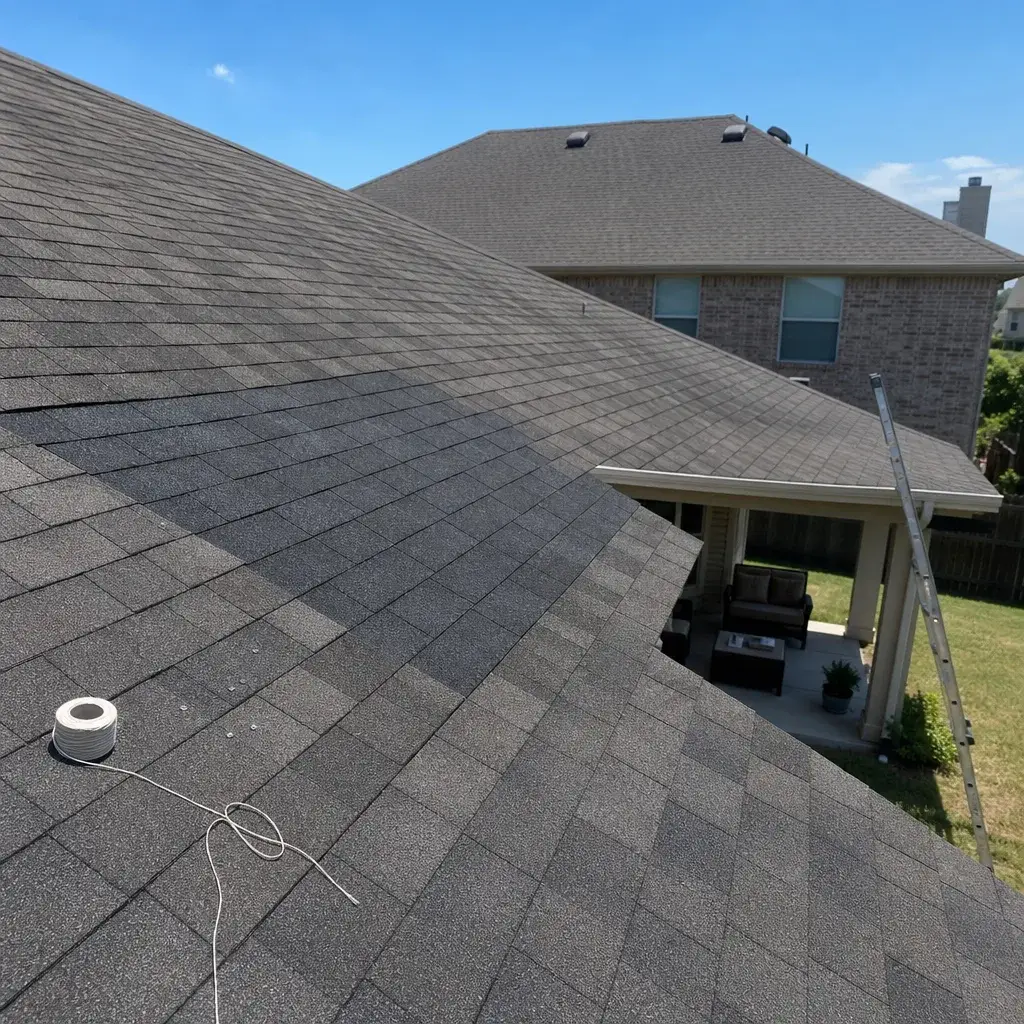
Whoever you call, a real repair inspection should look at more than the one spot over your ceiling stain. Here’s what a thorough one covers:
- Every slope, including the back ones you can’t see from the driveway. Wind and hail don’t always hit the side facing the street.
- The flashing at chimneys, walls, and valleys, plus the rubber boots around vent pipes, since those are common leak points.
- The attic under the stain, if it can be reached. Water trails on the decking or wet insulation help show whether the leak is really the roof or something else, like the attic AC we covered above.
- Any soft spots that point to rot underneath.
- Gutters and fascia, where granule buildup and spillover damage show up.
A good written estimate should leave you with no guessing. Look for these things on the page:
- Exactly what’s being fixed, and where on the roof.
- The materials being used, and how new shingles will be matched to faded old ones.
- What happens if rotted decking turns up once the shingles come off, and how that extra work is priced.
- Whether the job needs a permit, and who handles it.
- Cleanup, so nails and old shingles don’t end up in your yard or driveway.
Repair costs vary across the industry for a few reasons. A steep roof, or one on a tall two-story home, takes more safety gear and time than a low one-story ranch. Several problem spots cost more than one. Hidden rot under the shingles adds work nobody can see from the ground. Finding shingles that blend with an older, sun-faded roof can take extra effort too. If someone quotes you a firm number without walking the roof, ask how they got there.
If the damage looks storm-related, that’s part of the conversation too. We’ll walk you through the claim and explain what the inspection found, and when there’s a claim, your project manager can meet the adjuster. Nobody can promise what your insurer will approve. What we can tell you is simple: you pay your deductible, nobody else.
Once you approve the work, a project manager takes it from there. They coordinate materials, scheduling, and any permits or HOA approvals, and they keep you updated along the way. Our roofers protect your property and keep the site clean, and the job ends with a final walkthrough so you can see the finished work for yourself. ERO DFW is licensed, bonded, and insured, financing is available, and we’re headquartered right here on the U.S. 80 frontage road in Sunnyvale. If a question comes up next year, you’ll know exactly where to find us.
Need help with your roof repair project?
Schedule Your Free Inspection. Exteriors, Roofing & Outdoor Living is ready to help.
Storm and Hail Damage Repair and the Insurance Claim Process
After a hailstorm rolls through Sunnyvale, the first question is usually this: do I call my insurance company or a roofer first? For most people, a free inspection comes first. Hail damage is hard to judge from the ground. A hailstone can bruise a shingle and knock off its protective granules without leaving a hole, and that spot can start to leak a season or two later. An inspection tells you whether there’s real damage, and whether it’s likely to be more than your deductible, before you open a claim.
If the damage is real, here’s how a claim usually goes:
- Stop the water. If the roof is open, get it tarped, then take the photos and keep the receipts we talked about earlier.
- Call your insurer and file the claim. Write down your claim number and your adjuster’s name.
- The adjuster comes out. This is the person your insurance company sends to look at the damage. When there’s a claim, your ERO DFW project manager can meet the adjuster on the roof, so the damage we found gets pointed out in person.
- Read the insurer’s estimate. It lists what they’ll pay to fix and how much. Ask about anything that looks missing, like a slope that took hits or vents and gutters that got dented.
- The work gets done, and the paperwork gets closed out with your insurer.
One term to know before step four: depreciation. Many policies take off value for your roof’s age and may pay part of the money up front and the rest once the work is finished. Some older or cheaper policies only pay the roof’s depreciated value, often called ACV, or actual cash value. Your policy decides this, not the roofer, so it’s worth reading that page or asking your agent before the adjuster comes.
Now the deductible. Texas law is plain on this. You, the homeowner, pay your deductible. A contractor can’t waive it, cover it, rebate it, or hide it inside a padded estimate. That’s why our answer never changes: you pay your deductible, nobody else. If a roofer tells you otherwise, that’s not a deal. It’s a reason to close the door.
And there will be knocks on your door. After every big North Texas storm, crews from out of town fan out through the neighborhoods hit hardest. Some do fine work. Many are gone by the time a leak shows up next spring. Watch for these warning signs:
- They offer to “take care of” your deductible.
- They want you to sign something before you’ve talked to your insurer. Some of these papers are contracts that lock you in if the claim is approved.
- They want a large cash payment up front.
- They can’t give you a local office address you could drive to.
Nobody can promise what your insurance company will approve, and we won’t. What we can do is look at your roof for free, tell you whether you have a claim worth filing, and walk you through the claim if you do. We’re headquartered right here in Sunnyvale and family-owned since 2019. We’re still here after the storm, and still here for the warranty call.
Watch Our Video
See How We Handle Roof Repair in Sunnyvale, TX
Exteriors, Roofing & Outdoor Living — Serving Sunnyvale, TX and surrounding areas
What Drives Roof Repair Cost Up or Down
A roof repair can cost a little or a lot, and the gap usually comes down to what kind of roof you have, how much of it needs work, and when you get it fixed. Height, extra problem spots, hidden rot, and shingle matching all matter, as we covered above. A few other things move the price just as much.
Start with how roofers price the work. Small repairs are often quoted as one flat price for the whole job. Many contractors also have a minimum charge, because sending a crew and a truck costs money even for a ten-minute fix. Bigger repairs are often priced by the square, a roofing term for 100 square feet of roof. Leak hunting is sometimes billed by the hour, since nobody knows how long it’ll take to find the source. It’s fair to ask which way you’re being charged, so you can compare two bids on equal terms.
These things tend to push the cost up:
- Tile or metal roofing. Tiles crack if they’re walked on wrong, and matching pieces can be hard to find. Metal panels often have to be replaced as a whole panel, not patched in a small spot.
- Flashing work at a chimney or wall. Doing it right can mean lifting shingles around the joint, and sometimes taking out a few bricks or a piece of siding to tuck the new metal behind it.
- More than one layer of old shingles. Older roofs sometimes have a second layer nailed over the first, and both have to come off in the repair area.
- Peak storm season. After a big spring hailstorm between March and June, demand jumps all over North Texas, and materials can get scarce.
- Waiting too long. A cracked vent boot is a small job. The same boot left leaking for a year can rot the decking and stain the drywall below, and now you’re paying for three jobs instead of one.
These things tend to bring it down:
- Catching it early. A drip that just showed up is almost always cheaper to fix than one that’s been there a season.
- Fixing several small things in one visit. If you’ve got a loose shingle, a worn boot, and a gutter pulling away from the fascia, one trip costs less than three.
- A standard asphalt shingle roof on a one-story home. It’s the simplest repair to reach and match.
- Picking your timing when you can. If the problem isn’t letting water in, scheduling outside the rush after a big storm can help. An active leak shouldn’t wait, though.
If storm damage is part of a covered claim, your share may come down to your deductible, as we explained above. For repairs you’re paying for yourself, ERO DFW offers financing, so a needed fix doesn’t have to wait for a better month.
The only way to know your number is to have someone walk your roof and write it down. That’s what our free inspection is for: an honest opinion on repair versus replacement, and a clear estimate before you sign anything. We’re family-owned since 2019, headquartered on the U.S. 80 frontage road in Sunnyvale, and we’ll still be here after the storm.
Frequently Asked Questions
Common questions about roof repair in Sunnyvale, TX
How long does a typical roof repair take?
Most single-spot repairs, like a cracked vent boot or a few missing shingles, can be finished in a few hours by an experienced crew. Jobs with hidden rot under the shingles or flashing work at a chimney take longer, since the decking has to be checked and sometimes replaced. A free inspection gives you a real time estimate before any work starts, not just a guess.
Can I do a temporary roof patch myself before calling a roofer?
We’d rather you not climb up there. North Texas roofs get steep pitches and slick granule surfaces, and wet or hail-damaged shingles are even less safe to walk on. If water is actively coming in, cover what you can from inside with a tarp or bucket and call for emergency tarping instead of getting on the roof yourself.
Will a small roof repair affect my home’s resale value or inspection?
A well-matched, documented repair usually satisfies a buyer’s inspector, but shingle color can be a sticking point. Since Texas sun fades shingles over time, a patch with new shingles may look slightly different from the rest of the roof even though it performs fine. If you’re planning to sell soon, mention that to whoever inspects your roof so they can factor it into the estimate and explain your options.
What should I do if I notice a roof problem but I’m not sure it’s urgent?
Get it looked at soon rather than waiting, since small issues like a cracked vent boot or a loose shingle tend to get more expensive the longer they sit. A boot that leaks for a year can rot the decking underneath and stain your ceiling, turning a quick fix into a bigger repair. A free inspection can tell you whether it’s a same-week fix or something that can wait.
Ready to Get Started?
Schedule Your Free Inspection. Call (972) 288-9587 today.